The powerful James Webb Space Telescope (JWST) has given astronomers a glimpse into distant corners of our universe. The telescope’s latest discovery is one of the weirdest yet.
In a new publication in The Astrophysical Journal Letters, a research team has detailed the characteristics of the “enigmatic” planet PSR J2322-2650b, which is trapped in a toxic relationship with its star. The planet’s unusual shape and surprising atmosphere have flummoxed the researchers, who are still trying to explain the planet’s existence.
Read More: JWST Helps Examine Atmosphere of Exoplanet 40 Light Years Away and in the Goldilocks Zone
How to Spot a Pulsar’s Planet
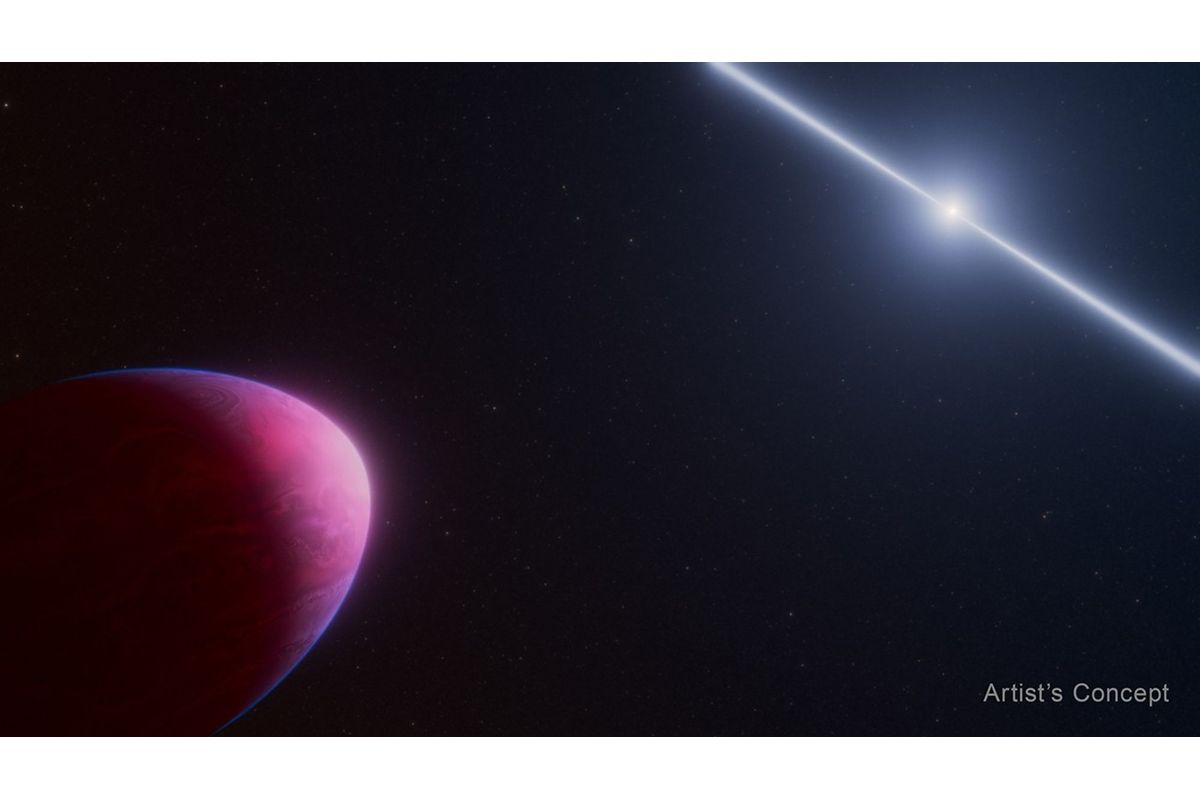
Artist’s concept of PSR J2322-2650b, the lemon-shaped exoplanet.
(Image Courtesy of NASA, ESA, CSA, Ralf Crawford (STScI))
PSR J2322-2650b is around the size of Jupiter, and orbits a star called a pulsar. A pulsar is the rapidly spinning remains of a massive star that has collapsed in on itself in the aftermath of a massive supernova explosion. PSR J2322-2650b spins roughly 700 times a second, making it a so-called millisecond pulsar.
The pulsar emits beams of radiation that can only be perceived when they are directly pointing at Earth. However, these beams are thought to be mostly gamma-ray radiation. The JWST operates in the infrared, so it isn’t blinded by the pulsar’s intense radiation, giving astronomers a clear view of the nearby PSR J2322-2650b.
“The planet orbits a star that’s completely bizarre — the mass of the sun, but the size of a city,” said the University of Chicago’s Michael Zhang, the principal investigator on the study, in a press release. “This is a new type of planet atmosphere that nobody has ever seen before,” he added.
Diamond Rain And A Rapid Orbit
PSR J2322-2650b is a lemon-shaped planet that has an atmosphere made of mostly helium and carbon. Clouds of carbon likely cause downpours of diamonds onto the planet’s surface.
Study co-author Peter Gao, who is an astronomer at the Carnegie Earth and Planets Laboratory, said the findings were “an absolute surprise” in a press release. “I remember after we got the data down, our collective reaction was ‘What the heck is this?’ It’s extremely different from what we expected.”
The planet orbits just one million miles away from its paired pulsar, which is thirty times closer than Mercury orbits our sun. At this distance, PSR J2322-2650b takes just eight hours to complete an orbit.
Such proximity to a spinning ball of collapsed star radiation is, understandably, not a great situation for PSR J2322-2650b. The pull of its dense neighbor has created the planet’s unusual shape. This type of planet-pulsar pairing is called a “black widow” system, named after the fearsome spider that devours its mate. Eventually, PSR J2322-2650b will also be eaten by its unstable pulsar.
The pulsar’s powerful presence has tidally locked PSR J2322-2650b, meaning that one side of the planet permanently faces the pulsar. That face is cooked by the star’s energy, warming it to a maximum temperature of 3,700 degrees Fahrenheit. The dark side of the planet, which only ever looks out onto the void of space, is frigid, reaching a minimum temperature of 1,200 degrees Fahrenheit.
Explaining How A Weird Planet Came To Be
At these temperatures, astronomers would expect carbon in a planet’s atmosphere to combine with other elements, like oxygen or nitrogen. Instead, PSR J2322-2650b is rich with pure molecular carbon. This makes it unique among planets studied by astronomers.
“Did this thing form like a normal planet? No, because the composition is entirely different,” Zhang said. “Did it form by stripping the outside of a star, like ‘normal’ black widow systems are formed? Probably not, because nuclear physics does not make pure carbon. It’s very hard to imagine how you get this extremely carbon-enriched composition. It seems to rule out every known formation mechanism.”
The researchers are still pinning down exactly how the planet’s unique atmosphere came to be. One possible mechanism may involve the planet’s carbon rain.
“As the companion cools down, the mixture of carbon and oxygen in the interior starts to crystallize. Pure carbon crystals float to the top and get mixed into the helium, and that’s what we see,” said co-author and Stanford University astronomer Roger Romani in a press release. “But then something has to happen to keep the oxygen and nitrogen away. And that’s where the mystery comes in.
“But it’s nice not to know everything. I’m looking forward to learning more about the weirdness of this atmosphere. It’s great to have a puzzle to go after,” Romani concluded.
Read More: James Webb Space Telescope Captures Smallest Exoplanet Ever Seen in Historic First
Article Sources
Our writers at Discovermagazine.com use peer-reviewed studies and high-quality sources for our articles, and our editors review for scientific accuracy and editorial standards. Review the sources used below for this article: