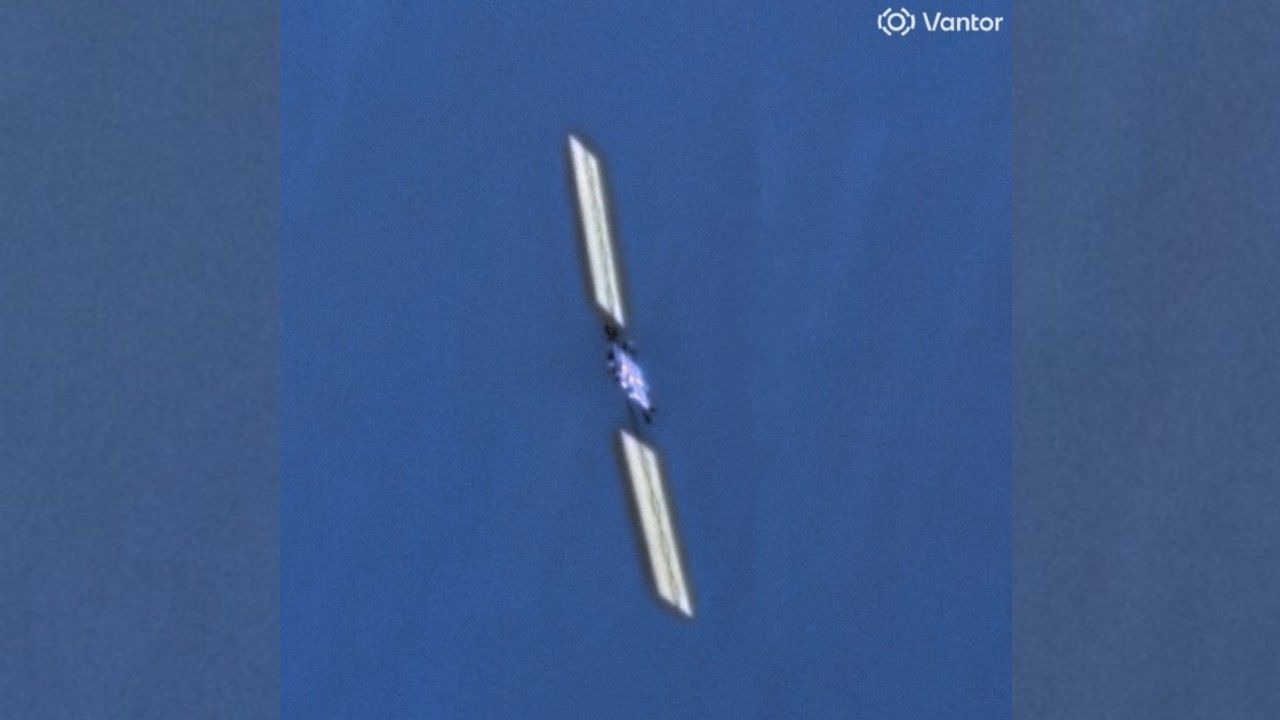
We just got a great up-close look at a SpaceX Starlink satellite in orbit, thanks to Vantor’s WorldView-3 spacecraft.
On Wednesday (Dec. 17), this particular Starlink suffered an anomaly that caused a loss of communication with the ground and an unscheduled venting of its propulsion tank. The satellite is now tumbling and headed down toward Earth’s atmosphere, where it will be incinerated in a matter of weeks, according to SpaceX.
The company used its WorldView-3 Earth-observing satellite to image the Starlink spacecraft on Thursday (Dec. 18) from a distance of 150 miles (241 kilometers).
The photo, taken while the duo were flying over Alaska, features a resolution of 4.7 inches (12 centimeters), providing SpaceX with key information about the satellite.
“Our team took advantage of the advanced capabilities of our non-Earth imaging technology and recently expanded collection capacity to move quickly and provide SpaceX with confirmation that their satellite was mostly intact,” Todd Surdey, Vantor’s executive vice president and general manager of enterprise and emerging products, said in a statement on Saturday (Dec. 20). “This rapid intelligence delivery enabled them to quickly assess possible damage to the spacecraft.”
Imagery collected by Vantor’s WorldView-3 satellite about 1 day after the anomaly shows that @starlink Satellite 35956 is largely intact. The 12-cm resolution image was collected over Alaska from 241 km away. We appreciate the rapid response by @vantortech to provide this… https://t.co/8OcTZsk5Gx pic.twitter.com/1PafjFwuRPDecember 20, 2025
There is apparently some damage: Data suggests that the satellite released a small number of debris objects as a result of the anomaly. But those pieces, and the satellite itself, shouldn’t a present a problem to other spacecraft in low Earth orbit (LEO), according to SpaceX.
“We appreciate the rapid response by @vantortech to provide this imagery. Additional data suggest that there is a small number of trackable debris objects from the event, and we expect the satellite and debris to reenter and fully demise within weeks,” Michael Nicolls, vice president of Starlink engineering at SpaceX, said in an X post on Saturday.
Starlink is by far the largest satellite constellation ever assembled. It currently consists of about 9,300 active spacecraft — about 65% of all the operational satellites in Earth orbit.