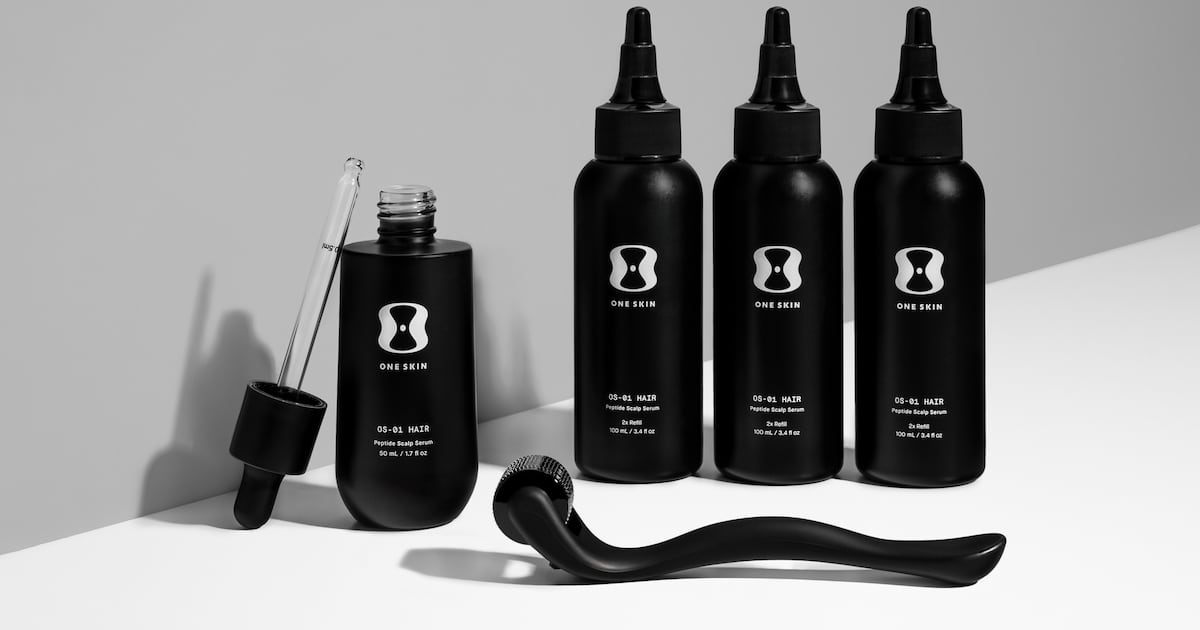
Amid snail slime serums, pulsed-light hair removal gadgets and Korean sunscreens on TikTok, a new kind of skin-care product is making the rounds. In one video, a white-coated scientist pipettes pink liquid into vials. In another, on Instagram, a woman with glittery ombre nails unboxes black-and-white bottles filled with futuristic youth serum. âWelcome to your skin-health and longevity journey,â the packaging reads.
If the pitch sounds more Palo Alto than Paris, thatâs because it is. Oneskin, begun by four Ph.D.s in a San Francisco biotech accelerator, is now a skin-care brand sitting at the intersection of beautyâs obsession with anti-ageing and Silicon Valleyâs fixation with outfoxing death. The companyâs lotions and serums, âproven to target a root cause of aging,â have attracted a fan base that includes a whoâs who of tech, biohacking and wellness types.
XPrize founder Peter Diamandis, a company adviser, texts Oneskinâs co-founder and chief executive officer, Carolina Reis Oliveira, whenever he runs out of product. Serial entrepreneur and Oneskin investor Kevin Rose talked up the brand on Tim Ferrissâ podcast, where he suggested the pioneering biohacker try the eye cream âon one eye for three months. Thatâd be f—ing cool, right?â Oliveira says self-help guru Tony Robbins uses Oneskin, as does Matthew McConaughey, whoâs said he uses the hair serum on his famous mane (an endorsement the company eagerly reposted on its social channels). âIt doesnât feel like youâre buying a beauty brand,â says Jane Carlson, managing editor of the trade publication Beauty Independent. âYouâre buying something for the longevity of your skin.â
Scienceâreal and dubiousâhas always been part of the sell in the skin-care aisle, where colorful jars of goop promise to plump, firm, brighten and smooth using ingredients that are âdermatologist-testedâ and âclinically proven.â For decades, brands pushed most of this as âanti-ageing.â Creams often used retinol or vitamin C, remixed with an ever-changing cast of exfoliants and antioxidants that promised to target fine lines and other visible signs of the passage of time. Skin longevity, on the other hand, claims to work deeper on the molecular causes behind those changes. The promise isnât simply to mask the signs of aging but to slow or even stop the process.
Oliveira and her three co-founders â all Brazilians with doctorates in tissue engineering, immunology and molecular biology â landed in San Francisco in 2016 to hatch a lab-testing service. Their platform would assess other companiesâ skin-care and cosmetics products by measuring the biological markers of aging in skin samples. But prospective investors shrugged. âNobody wants to back a service company,â as Oliveira puts it. So the co-founders invented their own product, aiming to nail âthe big opportunity,â she says. âIf it fails, it fails. But if it works, that can be a great return for everyone.â
Oneskinâs key ingredient is a custom molecule the founders designed to target whatâs known as cellular senescence, a natural part of aging in which damaged cells stop dividing and instead linger in tissue, causing inflammation. (Scientists jokingly call them âzombie cells,â which cause skin to sag, thin and grow dull, leading to wrinkles and a pallid, tired look.)
Once an obscure field of study in gerontology labs, cellular senescence became one of the hottest frontiers in aging research over the past decade, with senescent cells thought to help fuel everything from Alzheimerâs and heart disease to creaky joints. Labs at Stanford University and the Mayo Clinic have published studies on the science, and biotech companies have raised hundreds of millions of dollars to develop drugs based on it. âThere was a whole longevity field focused on senescent cells in the body, but no one was applying that to skin,â says Alessandra Zonari, Oneskinâs chief scientific officer and another co-founder.
The co-founders began screening hundreds of peptides â short chains of amino acids that act as biological messengers â using mathematical models to predict which ones might slow or reverse cellular aging. Eventually, in late 2018, a sequence stood out: Early tests on lab-grown skin showed that OS-01 appeared to reduce markers of senescence. They formulated the peptide into a moisturizer, confirmed it could penetrate the skin barrier and ran a small trial that showed visible differences when subjects used OS-01 on one side of the face and not on the other. The product was introduced in 2021 with sales through the startupâs website and eventually on Amazon.com.
Four years later, Oneskinâs $99 Face Topical Supplement is perfectly positioned for the peptide frenzy. Peptides are big in Make America Healthy Again (MAHA) circles, where the medicine-averse are embracing injectable versions promising muscle gain, sharper cognition and other benefits. Meanwhile, increasingly mainstream GLP-1 weight-loss drugs â also based on peptides â have normalised the idea of using biotech for elective purposes.
This all coincides with the beauty industry moving on from its decade-long obsession with âcleanâ ingredients in favour of effective ones. âI want to know this stuff actually works,âââ says Beauty Independentâs Carlson. That shift has created an opening for brands adept in science-speak, including newcomers such as Ourself and Droplette, which claim their patented delivery methods send ingredients deeper into the skin, âwhere no skincare has gone before,â as Ourself says on its website. Recasting beauty as science has also helped to attract men; Oliveira estimates that 17 percent of Oneskinâs customers are male.
Still, Oneskin works in a regulatory grey area similar to that governing dietary supplements. By describing its products as âtopical supplements,â it can hint at health benefits without triggering drug-level oversight â a strategy thatâs helped a generation of wellness brands sell probiotics, nootropics and the like with minimal US Food and Drug Administration scrutiny. âIf you want to get a product to people, this was the easiest way to do it,â says Paul Robbins, a University of Minnesota biogerontologist whose work on senescence helped establish the field and who first met Oneskinâs founders in 2018. âBut they have to just be careful what they can claim.â
The science itself is still emerging. Academic papers have just started using the term âskin longevityâ in earnest. A 2025 study in Frontiers in Aging proposed âskinspanâ as a measure of how long skin maintains youthful function and touted âlongevity cosmeceuticalsâ as transformative. Oneskin has published peer-reviewed studies on OS-01âs effects in lab-grown skin and small human trials â but those papers came from its own scientists; thereâs no independent evidence the peptide outperforms old-school standbys like retinoids.
That uncertainty extends to the mechanism behind Oneskinâs products. Robbins notes thereâs much more to learn about how best to target senescence in the skin, including whether a peptide is the most effective way to do it. Whatâs more, he says he doesnât understand how Oneskinâs peptide works. âHow is it actually affecting senescence?â he asks. âI donât think they really know.â Oneskin, for its part, has published research that starts to answer the question, but Oliveira agrees thereâs a lot more to investigate.
The company is now applying this science to different parts of the body, with products offering âfirm, bouncy lipsâ and âthicker, fuller, denser hair.â As a private company, Oneskin doesnât disclose its revenue or valuation, but Oliveira says itâs been profitable since 2022, growing more than 50 percent annually. As of late 2024, it had raised $20 million in venture capital, with backers including Unilever Ventures, the investment arm of the consumer products giant.
Other companies are getting into the longevity game. Estée Lauder Cos. assembled a panel of aging-science researchers to advise it and last year released a line of products focused not on removing senescent cells but activating proteins that influence cellular repair. It uses a synthetic ingredient Estée Lauder developed called Sirtivity-LPâalong with, naturally, black diamond truffle extract, 24-karat gold and a powder from ground-up pearls. French skin-care brand Caudalie targets the same so-called longevity proteins with an extract from the bark of the African mahogany tree. And why not? If thereâs one thing the beauty industry has mastered, itâs finding a new way to sell youth in a bottle.
By Tom Foster
Sign up to The Business of Beauty newsletter, your complimentary, must-read source for the dayâs most important beauty and wellness news and analysis.