

The Mustang has never had a shortage of admirers. For decades, the pony car has carried the performance banner for the entire brand, becoming the car people reached for whenever they wanted something that looked and sounded aggressive. However, the focus on one nameplate meant a lot of genuinely great machines got buried in its shadow, even though some were actually better muscle cars than the Mustang by almost every measure that actually matters on a road or a racetrack.
Throughout the 1960s and 1970s, while buyers lined up for Mustangs, Ford was quietly dropping the same engines (built by the same engineers and often with the same ambition) into other platforms. Some of these cars packed bigger engines than the Mustang offered that same year, yet many cost less to buy today, which says less about their quality and more about how thoroughly the Mustang dominated the conversation. A few have quietly appreciated in value while collectors chased more obvious targets, while others were rarer right from the factory.
That’s the essence of this list: pulling these cars out from under that shadow. The selection covers a range of decades, body styles, and engine families, but the common thread through all of them is that each one has great performance without leaning on the Mustang’s name.
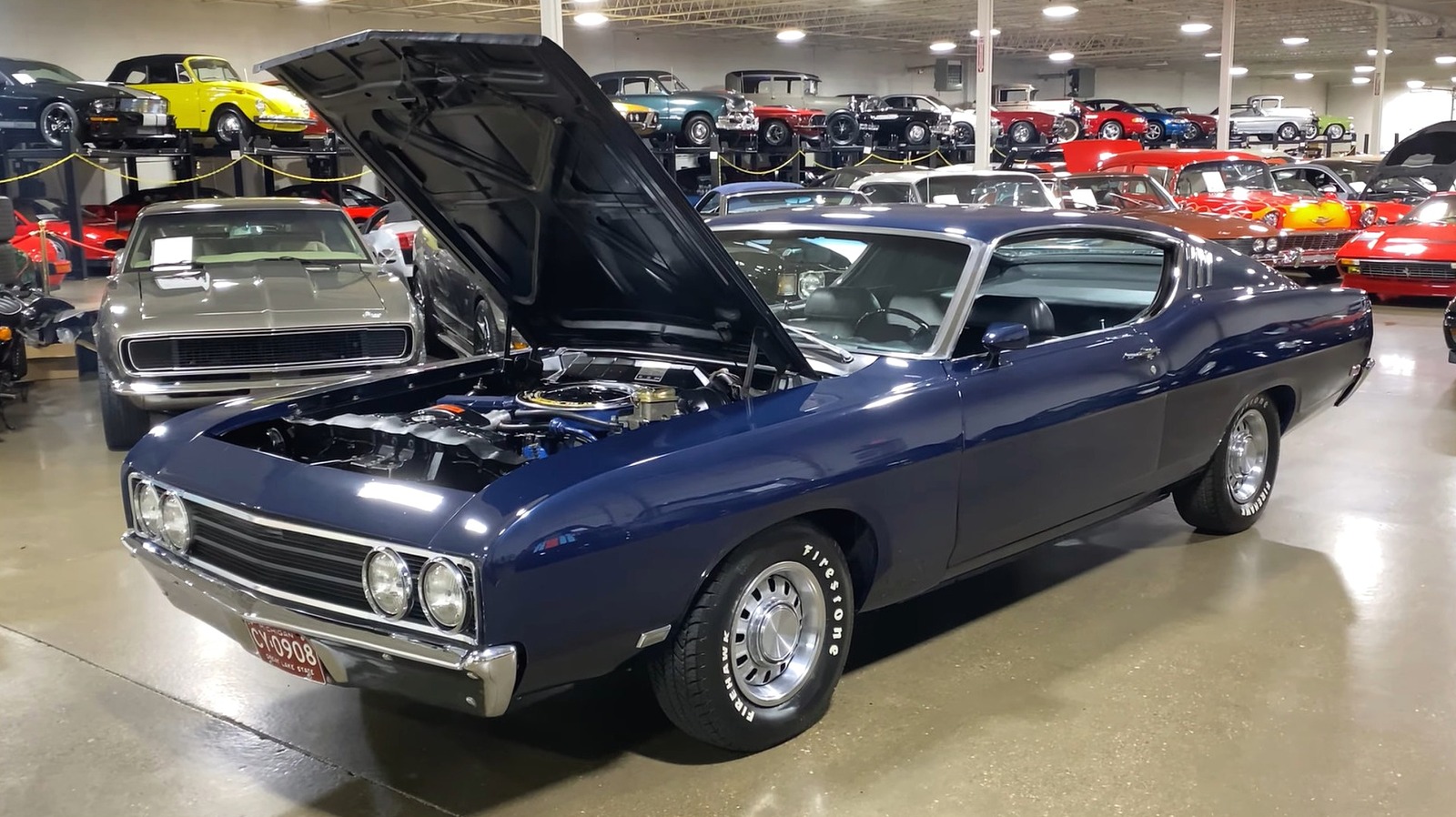
1969 Ford Torino Talladega
One of the coolest muscle cars of 1969 is the Ford Torino Talladega, and it exists purely because of the NASCAR rulebook. It all happened when Ford was required to generate around 750 street-legal units of the Torino Talladega to satisfy stock car racing’s homologation requirements. To meet that obligation, Ford and Holman & Moody built a full-size muscle car wrapped in aerodynamic bodywork that drew obvious comparisons to the Dodge Charger Daytona and looked nothing like anything else wearing a Ford badge that year. Each car left the factory finished in one of three colors: Royal Maroon, Wimbledon White, and Presidential Blue.
Despite carrying a unique “T” badge, the Talladega shared its roots with the standard Torino lineup, though in execution it felt closer to a purpose-built fastback. It had reshaped rocker panels, a recessed grille sitting flush with the bodywork, a reworked nose cone, revised exhaust routing, and tail-mounted wings that worked together to cut through air far more efficiently than the production Torino it was derived from. Under that stretched and sculpted shell sat a 7.0-liter 428 Cobra Jet V8, which was good for 335 horsepower and 440 lb-ft of torque, having taken over from the outgoing 427-cubic-inch engine. Power reached its rear wheels through a three-speed Cruise-O-Matic auto, while its Wide Oval tires kept the car planted at the contact patch and a track-tuned suspension setup held everything together, as the Talledega pushed toward speeds of 130 mph.
1973 Ford Falcon XB GT
The Ford Falcon XB GT is one of the coolest muscle cars to come out of Ford Australia, but beyond a shared honeycomb pattern stamped into the grille, it bore little connection to the Mustang. It was wrapped in proportions more aggressive than almost anything else on the road at the time, and Ford never officially brought it to American shores. Engine choices ran from a 351ci Cleveland V8 down to a 302ci V8, with a four-speed manual top-loader gearbox sitting behind either configuration. Backing it all up was a distinctive Glenroy exhaust with an organ-pipe note that announced its arrival well before anyone laid eyes on it, and once they did, the sight of its two chrome hood scoops and round Bathurst headlights made it so dashing.
On a proper setup — a Weiand-branded supercharger, four-valve cylinder heads, and a pair of Holley four-barrel carburetors working together — the XB GT could be tuned to produce as much as 540 horsepower, putting it well ahead of most American muscle cars from the same era. Still, none of that would have carried much weight outside Australia if Mad Max hadn’t shown the car in the early 1980s. That single film appearance is what really locked it in its collectible status for good. If you happen to come across one today, know that there’s a real chance it could be worth a small fortune down the road.
1968 Mercury Cougar GT-E
Think of this next Ford muscle car — the 1968 Mercury Cougar GT-E –- as a more elevated take on the XR-7 trim, finished in Cardinal Red color and set apart by a grille finished in matte black, raised dome-style hood scoops, and a set of four exhaust outlets, putting it in the same category as the Mustang and the Thunderbird. With production landing at roughly 397 units built and even a cameo in a James Bond film, it still remains one of the rarest and most overlooked muscle cars to come out of Ford’s family tree.
Powering it all was the 427 side-oiler, a 7.0-liter V8 from Ford’s FE-series lineup that would later influence the design of engines such as Boss 429 and 302. It produced 390 horsepower, fed by a Holley four-barrel carburetor, running a hydraulic camshaft, and exhaling through an exhaust manifold cast in iron before exiting via the quad tips at the back, though Ford eventually swapped it for the 428 Cobra Jet, which brought output down to around 340 horsepower. Plus, some of those 428-equipped cars came paired exclusively with a four-speed manual Top Loader instead of the three-speed Select-Shift Merc-O-Matic automatic gearbox and notably skipped air conditioning entirely despite the heat these engines were known to generate.
1970 Ford Torino Cobra
Next is the Ford’s Torino Cobra, and for this muscle car, they made over 7,675 examples, each one wrapped in a body wearing a grille finished in matte black, Cobra badging, a hood-mounted shaker scoop available as an add-on, and a race-ready suspension package with specially tuned rear shocks that made the car feel planted in a way the Mustang’s smaller chassis never quite matched, and yet, despite all that it never got the recognition it earned when it rolled out in 1970.
Every unit left the factory with one of Ford’s 385-series engines already installed –- specifically the 429 Super Cobra Jet, mounted up front in a cast-iron block, fueled through a Holley four-barrel carburetor from the 4150 lineup, and backed by lifters built for solid-cam operation, guide-plate-equipped rocker arms, properly set valve clearances, and iron exhaust manifolds routing spent gases through a double two-inch exhaust system internally.
The power produced landed at 375 horsepower and 450 lb-ft of torque whether buyers chose the basic close-ratio Ford Toploader four-speed manual or opted for the three-speed Select-Shift Cruise-O-Matic automatic instead; on top of that, if you get the available drag-oriented package along with the Ram Air system, that number can push past 450 horsepower, all fed from a 22-gallon tank. With a sprint to 60 mph of just 5.8 seconds on rear wheels, it stood as one of the quickest muscle cars of its decade.
1969 Mercury Cougar Eliminator
The Mercury Cougar Eliminator is a classic slice of American muscle that’s hard to go wrong with, and Ford kept in production for just 48 months –- 1969 saw 2,250 units built, then 2,268 examples in 1970 –- across a palette of just four colors, each fitted with a hood scoop, rocker panel treatment, and front spoiler that announced its intentions from the front bumper.
On the power front, buyers entered at a 351-cubic-inch Windsor V8 putting out 290 horsepower routed through a three-speed manual gearbox, with a four-barrel carburetor feeding it and a choice of Toploader four-speed or Select-Shift automatic for those who want something different. From there, the lineup climbed to a 6.5-liter 390 found in roughly 260 Eliminators, which was good for 320 horsepower when paired with a three-speed manual as the default choice, then a 351 4V produced 300 horsepower, and finally the 428 Cobra Jet (just 302 examples) made 335 horsepower thanks to a beefed-up crankshaft and reinforced rear shocks that handles the extra load behind the optional C6 automatic or the standard four-speed manual.
An optional Boss 302 also made the order sheet paired with a four-speed manual for a good 290 horsepower, though that engine was known for its issues with the piston skirt. Rust was another concern, appearing first in areas like the quarter panels and front fenders, much like the mustang –- a comparison that holds up well since parts interchange between the two so easily, especially given the fact that the Eliminator measures just three inches longer.
Methodology
Every car on this list had to meet a few core criteria, starting with a genuine connection to Ford’s performance lineage whether it rolled off the line under the Ford badge itself or came from a Ford-owned subsidiary. From there, styling and presence came into play, because a true muscle car needs to look the part: blacked-out grilles, hood scoops, quad exhaust tips, and body lines that echo the Mustang’s own design language were all factored heavily into separating genuine muscle cars from vehicles that simply happened to carry a big engine. Just as important, though, was distance from the Mustang itself. Each pick needed real separation, whether through a different platform, a different purpose, or an entirely different spot in the market.
To keep the list accurate, every spec and performance figure was cross-referenced across trusted automotive sources like Hemmings, Hot Rod, Motor Trend, AutoEvolution, and Hagerty. This mattered especially for cars from the late ’60s and early ’70s, when production numbers and factory ratings tend to shift from one source to the next; in those cases, whichever figure appeared most consistently across multiple outlets was the one used.
The car’s engineering also carried equal weight in the final judgment. Details like carburetor setups, transmission options, and the underlying architecture underneath each car all played a role in determining whether it truly belonged in the same conversation as Ford’s most celebrated performers.

