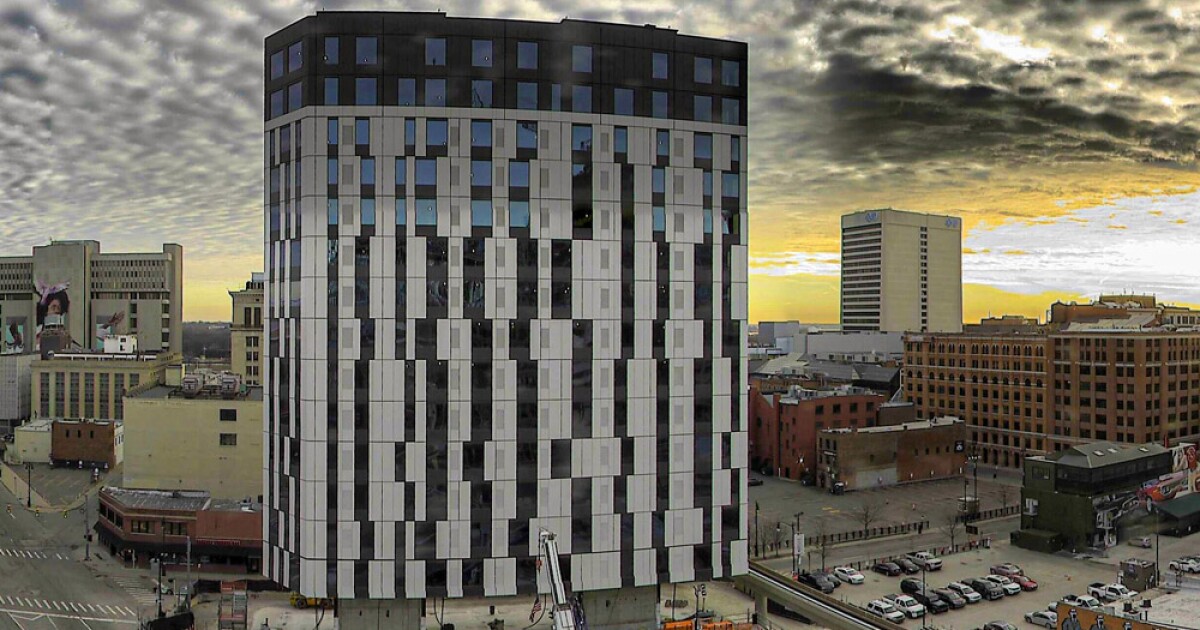
An awkward, triangular site near the Greektown neighborhood was chosen for the project, since according to the developers, it wouldn’t have been possible to build a tower of this height using traditional construction methods – the elevated People Mover system running right next to it would’ve prevented the use of tower cranes.
Liftbuild’s construction system is a hyper-modular version of a “lift slab” technique that has its roots back in the early 1950s. In its latest iteration, though, it works something like this: first, the foundations are prepared, and a number of central spines are built, housing stairs and elevators, to the full height of the building.
Then, each floor beginning with the roof is built close to the ground, from the steel frame and concrete slab, to the facade, flooring, any walls, electrics, plumbing, fire protection, ducting and the like.
Liftbuild/Barton Marlow
Co-ordinating with various contractors, Liftbuild makes sure everything possible is done on the ground, making for a factory-type assembly area where pre-fabricated parts can quickly be fitted and lifting is kept to a minimum. Anything that needs to be fitted underneath the slab can be done by jacking the whole thing up around the spines to an easy working height.
Once each 500-ton floor is ready, it’s lifted to the top of the spines on some eight powerful strand jacks, the top floors taking about 10 hours to lift. And once in place, a proprietary bolted connection locks the floor to the spines permanently. In the case of the Exchange building, there are no further structural supports or trusses involved; each floor is a cantilevered design held up solely by the two spines, so there are no exterior columns blocking the view from residents’ windows. Indeed, there are no further interior walls or columns set in stone other than the two spines, so designers can go to town on each floor and lay it out however they like.
Liftbuild’s parent company Barton Marlow led the design and construction, and also financed the project as a demonstration of its capabilities. The company says it should be a huge leap forward in terms of worker safety, since once the spines are up, nobody has to work at height or hang from ropes on the exterior.
And of course, it should make these things cheaper and faster to put up; Liftbuild says as much as 10-20% cheaper, and up to 50% quicker than a regular construction, using significantly fewer workers, although it’ll need to prove these claims out in subsequent builds as its methods improve and its construction partners and contractors find ways to use the system optimally. Either way, there’ll certainly be a lot less going up on cranes or getting carried up the stairs.
As of late January, all the liftable floors have been lifted and secured in place, leaving just the two bottom floors, which will be built conventionally. “We’re very pleased with the outcome of our first proof of concept for the Liftbuild technology,” said Liftbuild Chief Operating Officer Joe Benvenuto in a brutally buzzword-heavy press release. “The implementation of our proprietary methods has now been proven to produce the advantages we were anticipating, and we are confident that the results achieved at the Exchange Building will set the stage for a broader commercialization of Liftbuild. With this milestone, we will now transition our focus to our next opportunity to deploy the Liftbuild methodology as we strive to deliver increased safety, labor efficiencies, and reduced schedules for our project stakeholders. “
Liftbuild/Barton Marlow
While the Exchange represents an American first for this kind of building technology, earlier and less complete versions of the lift-slab concept have been used before. Probably the best known is the L’Ambiance Plaza in Connecticut, which collapsed during construction due to shoddy oversight and poor planning, killing 28 workers.
More recently, TGE LLC used a technique much closer to Liftbuild’s in 2018, for the construction of a couple of 10-storey L-shaped office buildings in Bangalore, India. You can see how an earlier TGE build went up in the timelapse below.

SRR3 New Construction 2017
Source: Liftbuild via Engineering News-Record