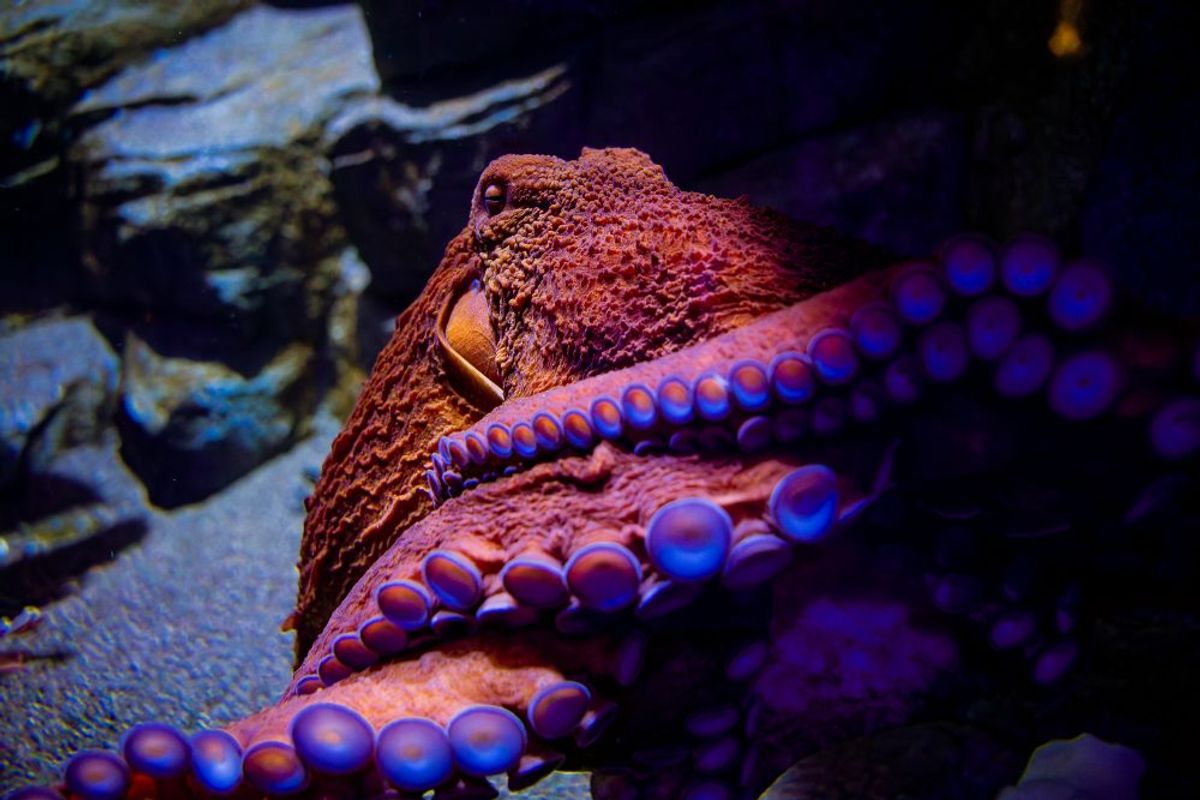
Key Takeaways on Octopuses Changing Color
- Octopuses change color to camouflage themselves from predators such as stingrays and eels. Octopuses have even been observed changing color in their sleep.
- Octopus’s color-changing ability is known as metachrosis or physiological color change. In addition to color change, octopuses can alter their skin patterns to better blend in with their surroundings.
- According to experts, octopuses can change color in the “blink of an eye,” though this process can be exhausting and take up a lot of energy.
At the Birch Aquarium in San Diego, visitors might see a grey Giant Pacific Octopus snoozing in her habitat. But a few minutes later, they might see a bright red octopus accepting a fish snack from a staff member. Is the octopus changing colors because she’s excited?
“Giant Pacific Octopuses change colors all throughout the day, and as humans, we naturally want to attribute those changes to certain emotions, but rather there are certain color patterns that correspond with certain behaviors,” says Maddy Tracewell, a senior aquarist for animal health at the Birch Aquarium at the Scripps Institution of Oceanography at UC San Diego.
A sleeping octopus is often white or grey in color to match their environment.
“When they sleep, they are also usually tucked away in their den and not very interactive. Usually, the most color changing happens when they are awake. The colors of an octopus can change faster than the blink of an eye! It is pretty spectacular to watch,” Tracewell says.
When an octopus senses danger, it changes color quickly. And while these creatures are masters of disguise, they are also color blind. Scientists are currently discovering how octopuses can match colors they can’t even see.
Read More: Octopus Arms Can Punch, Lift, and Sometimes Pull 100 Times the Sea Creature’s Own Weight
Octopuses Change Color Rapidly
Physiological color change, also known as metachrosis, is an animal’s ability to rapidly and temporarily change their appearance. For octopuses, physiological color change also includes the ability to change their pattern to blend in with a textured background, according to a 2022 study in Vision.
Because they can change colors and patterns within milliseconds, scientists consider octopuses to be champions of camouflage — especially because octopuses cannot even perceive some of the colors they match.
How Do Octopuses Change Color?
In the same Vision study, researchers questioned how a color-blind animal could so effectively camouflage itself. Octopuses’ chromatophores (the cells that produce color) are thought to respond to an object’s brightness, rather than the hue.
To test how closely an octopus could match a background color, the researchers worked with the gloomy octopus (Octopus tetricus), a medium-sized octopus living near Australia that was named for its sad-looking eyes, which give off an Eeyore vibe.
The researchers used a spectroradiometer to measure whether the gloomy octopuses were actually matching the background colors. They found that the octopuses could camouflage themselves against a background in terms of lightness and chromaticity. But they were not always able to achieve the same saturation levels.
The authors concluded that octopuses most likely evolved to be undetectable to underwater predators (as opposed to birds flying above or humans casting nets). Brightness, rather than exact shade matching, is more important when avoiding predators such as sharks or eels.
Why Do Octopuses Change Color?
Scientists think that octopuses evolved to change colors as a predatory defense. A stingray or an eel can’t snatch and snack on an octopus they can’t see. But they have also identified other situations in which an octopus changes color.
In a 2021 study in iScience, researchers found that octopuses change color during sleep and hypothesize that they have distinct sleep stages with more active periods. During the active stage of their sleep cycle, octopuses may have movement in their suction cups and change colors.
Changing colors is apparently so easy for octopuses that they can do it in their sleep. But it also comes at a great expense, according to a study in PNAS. Octopuses burn up a lot of energy when they change colors. To offset this major metabolic burn, octopuses have adapted to be nocturnal and to rest in dens and other safe spaces.
And should their camouflage fail them, octopuses can regrow limbs if a predator chomps one off. When the current Giant Pacific Octopus first came to the Birch Aquarium in March 2025, she had lost one of her limbs while living in waters near Japan.
“Octopuses have the ability to regenerate their arms, so it has been amazing seeing this process in action. Every month her tiny ‘nubbin’ arm grows bigger and bigger, and eventually we will probably be unable to tell it apart from her other arms,” Tracewell says.
Read More: Do Octopuses Dream? Their Colorful, Skin-Changing Sleep Cycles May Hold the Answer
Article Sources
Our writers at Discovermagazine.com use peer-reviewed studies and high-quality sources for our articles, and our editors review for scientific accuracy and editorial standards. Review the sources used below for this article: