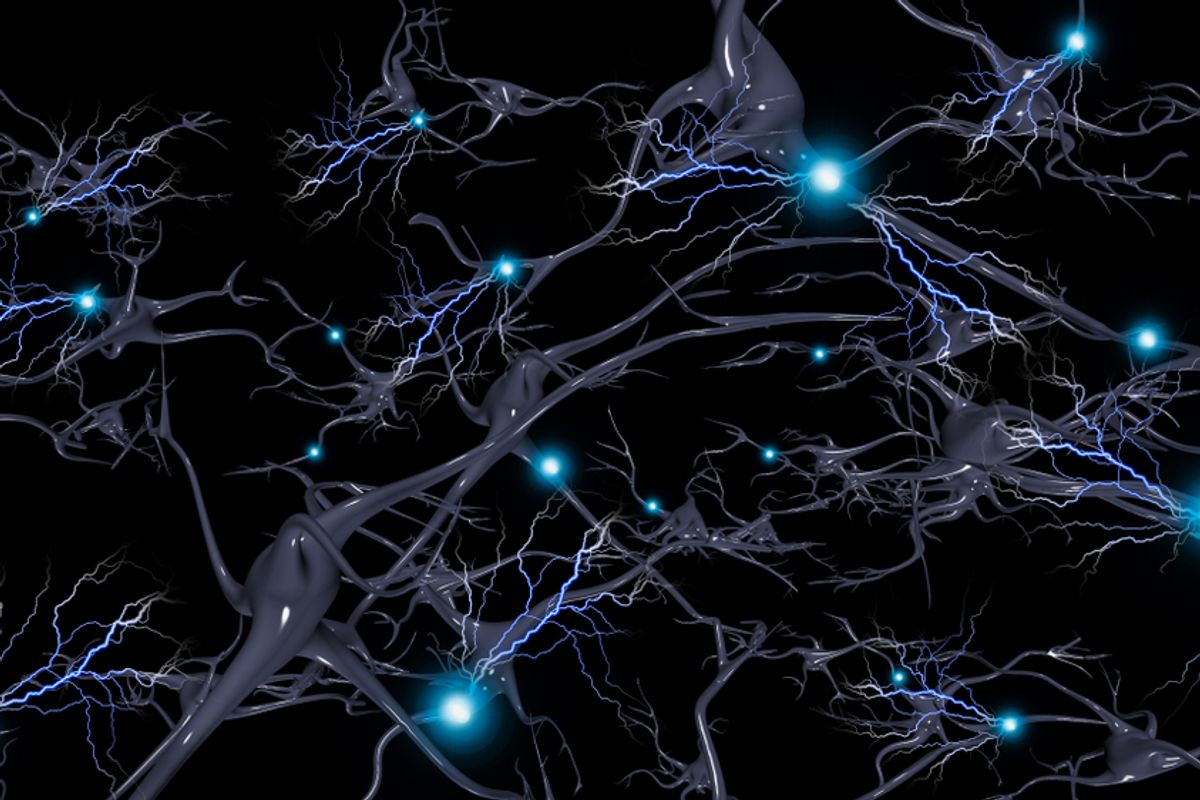
Studying the activity of brain cells has never been straightforward. The central nervous system is incredibly complex, and unraveling the dense mesh of bioelectrical signaling inside is like trying to put an 85-billion-piece jigsaw puzzle together. One of the biggest challenges in this undertaking has been that researchers have previously been able to measure only the signals that individual brain cells produce, not those they receive.
Now, a protein with a very unusual name has given neuroscientists a look into the signals entering brain cells.
Read More: Brain Microchip Smaller Than a Grain of Salt Sends Data Using Lasers and Satellite Technology
Creating the iGluSnFR4 Protein
The carefully modified protein, developed by a team at the Allen Institute and the Janelia Research Campus at the Howard Hughes Medical Institute, records the complex chemical signals that electrically active neurons use to communicate. The most common of those chemicals is called glutamate. It’s essential for brain processes like thinking and memory.
Because it detects the level of glutamate released by neurons, it has been called iGluSnFR4 (‘glue sniffer’). A new Nature Methods paper shows off the latest generation of glue sniffer protein, which overcomes significant barriers that previous versions faced.
Tracing Signals In The Brain
To understand why a tool like the glue sniffer has been so sought after in neuroscience, it’s important to understand how brain signaling works. The output of a single neuron is (relatively) simple to understand. These cells fire out electrical signals that travel down cable-like axons until they reach the neuron’s broadcast area, called a synapse, where they are converted into chemical messengers called neurotransmitters, like glutamate, which can ‘jump’ the gap between cells.
What triggers that electrical and then chemical signal is much more complex: neurons receive neurotransmitter inputs from potentially thousands of other brain cells. Neurons interpret these signals and determine whether they should fire off their own electrical signal in response. However, these chemical inputs have always been too faint and too rapid to be reliably measured.
Before glue sniffer proteins, neuroscientists were essentially unable to hear half the electrical conversation that occurs between cells in our brain.
“Neuroscientists have pretty good ways of measuring structural connections between neurons, and in separate experiments, we can measure what some of the neurons in the brain are saying, but we haven’t been good at combining these two kinds of information. It’s hard to measure what neurons are saying to which other neurons,” said Kaspar Podgorski, a study co-author and neuroscientist at the Allen Institute, in a press release.
Glue sniffer proteins change that.
“It’s like reading a book with all the words scrambled and not understanding the order of the words or how they’re arranged,” said Podgorski. “I feel like what we’re doing here is adding the connections between those neurons, and by doing that, we now understand the order of the words on the pages, and what they mean.”
Listening To The Brain’s Hidden Conversations
In the new paper, the team shows off a pair of proteins, iGluSnFR4f and iGluSnFR4s, that measure rapid signals and those produced by large groups of brain cells, respectively.
The team demonstrated that the proteins could measure mouse brain activity in a series of experiments, indicating activity via a fluorescent signal that could be imaged with a microscope.
The authors hope that the tools could help neuroscientists understand the computations that enable the brain to function. The tools could also help understand what happens to our brain when glutamate signaling is disrupted in conditions like schizophrenia and epilepsy.
“What we have invented here is a way of measuring information that comes into neurons from different sources, and that’s been a critical part missing from neuroscience research,” concluded Podgorski.
Read More: Our Brains May Have Pre-Configured Instructions to Understand the World When We’re Born
Article Sources
Our writers at Discovermagazine.com use peer-reviewed studies and high-quality sources for our articles, and our editors review for scientific accuracy and editorial standards. Review the sources used below for this article: