âIs there anything worth seeing in Latvia?â asked a bemused friend when I explained my destination. âOther than Riga?â Latviaâs capital is certainly worth a visit: a wonderland of perfectly preserved art nouveau architecture with a medieval centre of narrow cobbled streets and enough quirky museums to satisfy the most curious of visitors â most of whom just come for a weekend.
But a short drive or bus ride west of Riga lies another, more expansive and completely empty, wonderland: a wild, post-Soviet landscape of untouched forests, ecologically renowned wetlands, windblown beaches and crumbling castles. Not to mention the newly restored baronial estates where you can stay for the price of an average British B&B. This region, known as Kurzeme, is almost the size of Yorkshire (population: 5.5 million) but with a mere 240,000 inhabitants.
Kurzeme (also known by its German name, Courland) has 180 miles of undeveloped coastline and a good proportion of Latviaâs 1,200 castles and mansions, as well as the ancient valley of the Abava River, listed by World Monuments Watch as one of â100 endangered unique cultural monumentsâ.
It also boasts KuldÄ«ga, a Unesco world heritage town, and LiepÄja an upcoming European capital of culture (2027) â full of languishing art nouveau architecture, and enough former Soviet collective farms, KGB watch towers and military barracks to remind us that history really is just a breath away.
The Latvian bus system is excellent and extremely cheap but I rented a car for a few days to maximise my time. My tour began in Sabile, a town on the River Abava â whose crystalline, beaver-filled waters flow from Kandava to KuldÄ«ga (Sabile is also home to several vineyards where Latvian wine can be tasted). Here, one misty cacophonous morning, I casually flipped open my Merlin birding app. Within minutes it had identified 25 birds including sedge warblers, golden orioles and spotted fly catchers and I had seen marsh harriers. Apparently such a wide variety is perfectly normal: Latviaâs bogs, wetlands, coastal lagoons and ancient forests (53% of the country is woodland while 5% is wetlands) make it one of northern Europeâs best birding sites.
Just a few minutesâ drive outside town is the PedvÄle Art Park, a 100-hectare nature reserve where storks pick their way through swathes of wild lupins and 195 contemporary sculptures from across the world. Founder OjÄrs Feldbergs told me the Abava valley is home to 800 species of plant and animal, as well as crusader castles and Viking graves. âIt was once a trading route for amber,â he tells me. âThe Baltic Sea is the worldâs richest source of Baltic gold, which was transported to St Petersburg and the east through this valley for centuries.â
Later, the bucolic beauty and clean waters of the Abava valley, along with its therapeutic sulphur springs, attracted hundreds of German aristocracy, giving the region a disproportionate number of baronial estates. Though these fell into disrepair during the Soviet era when they became collective farms, tractor houses and pig farms, in the past decade many have been painstakingly restored as boutique hotels.
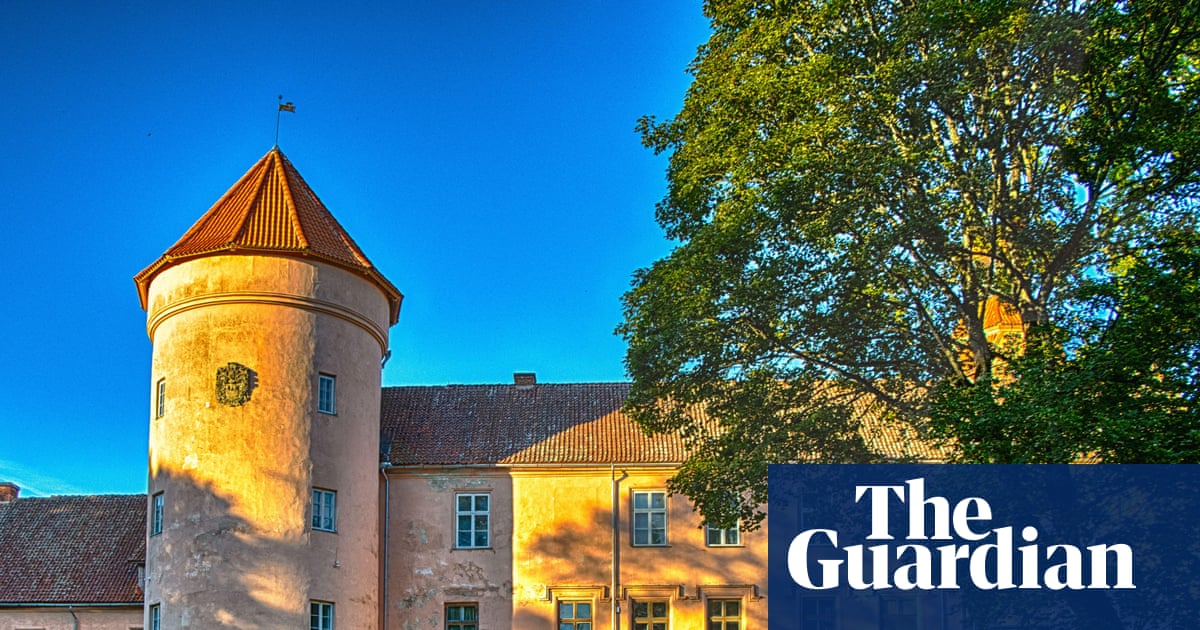
At KukÅ¡u Manor (guided tour â¬5), I gawped at lavishly painted ceilings and jaw-dropping frescoes. Here, for â¬185 for a double room, anyone can live, fleetingly, as a Baltic baron. Just north of the valley, I strolled in the walled gardens, vineyards and frescoed state rooms of Nurmuiža Castle and Spa, an elegantly restored estate where you can dip in a wild swimming lake as cranes and storks fly overhead, and double rooms cost from â¬80. Alternatively, at Padure Manor near KuldÄ«ga, a reconstruction-in-progress often used for film sets, â¬40 will buy you a bedroom and access to the musty Soviet library that came with the house.
KuldÄ«ga itself, a charmingly dusty town, became Unesco-protected in 2023, thanks to its 17th-century wooden architecture and striking location above Europeâs widest waterfall, the Venta Rapid â crossed via Europeâs longest brick road bridge. The high street â not a single chain store in sight â includes a needle museum, a renovated merchantâs house, and craft shops where I splashed out on handknitted socks for my kids.
At PagrabiÅÅ¡, which locals assured me served some of the best Latvian food in Kurzeme, I slurped delicious salty sour soup known as solyanka with a slice of Latviaâs famously dense, chewy rye bread. Afterwards, a 30-minute drive â including a stop-off at the pink, fairytale Ädole Castle â took me to JÅ«rkalne, a pretty and utterly deserted beach of bluffs, dunes and pine trees. PÄvilosta, the latest hotspot beloved of Rigan hipsters, lies to the south: an old fishing village where you can grab a flat white (try Cafe Laiva) and watch the rolling Baltic surf or cycle the EuroVelo 13 coastal track to LiepÄja.
Itâs here, in Latviaâs third largest city that I end my trip. With its lush parks, sandy white beaches and strollable streets of gently decaying baroque and art nouveau buildings, LiepÄja makes a great base for exploring the south-west corner of Kurzeme. I stayed in the historic Art Hotel Roma (doubles from â¬80 a night which includes access to the hotelâs art collection) and ate as often as I could at an exquisitely restored lodgings once frequented by Peter the Great: Madame Hoyerâs Guest House. Although itâs now a museum, the dining room operates much as it did in 1697.
But LiepÄjaâs greatest attraction must surely be Karosta, once one of the USSRâs largest submarine bases, and a closed military zone for nearly 50 years. Today, itâs a ghostly swill of pristine coastline, brutalist architecture and graffitied Soviet watch towers, with the gold-encrusted domes of the Russian Orthodox St Nicholas Naval Cathedral gleaming, surreally and extravagantly, from its midst.
To fully grasp Latviaâs extraordinary, violent history, I took a guided tour of Karosta prison, one of only a few former military jails in Europe open to visitors. Here, windowless cells once housed revolutionaries, miscreant soldiers and officers of the tsarist army, the Soviet army, the Latvian army, as well as deserters of the German Wehrmacht and âenemiesâ of Stalin â many of whom had used their metal buttons to scratch their initials into the concrete walls. A little unusually, Karosta prison offers all-night stays (ranging from â¬15-60 a night) for anyone not averse to paranormal activities â itâs been voted the most haunted place in the world by Ghost Hunters International. I opted, instead, for a recuperative beer from one of LiepÄjaâs burgeoning microbreweries, mulling over an intriguing part of the world, far from the usual tourist haunts.
The writer travelled independently using the extensive network of Kurzemeâs tourist information offices and with help from latvia.travel. For information on castle and manor house stays visit latvia.travel