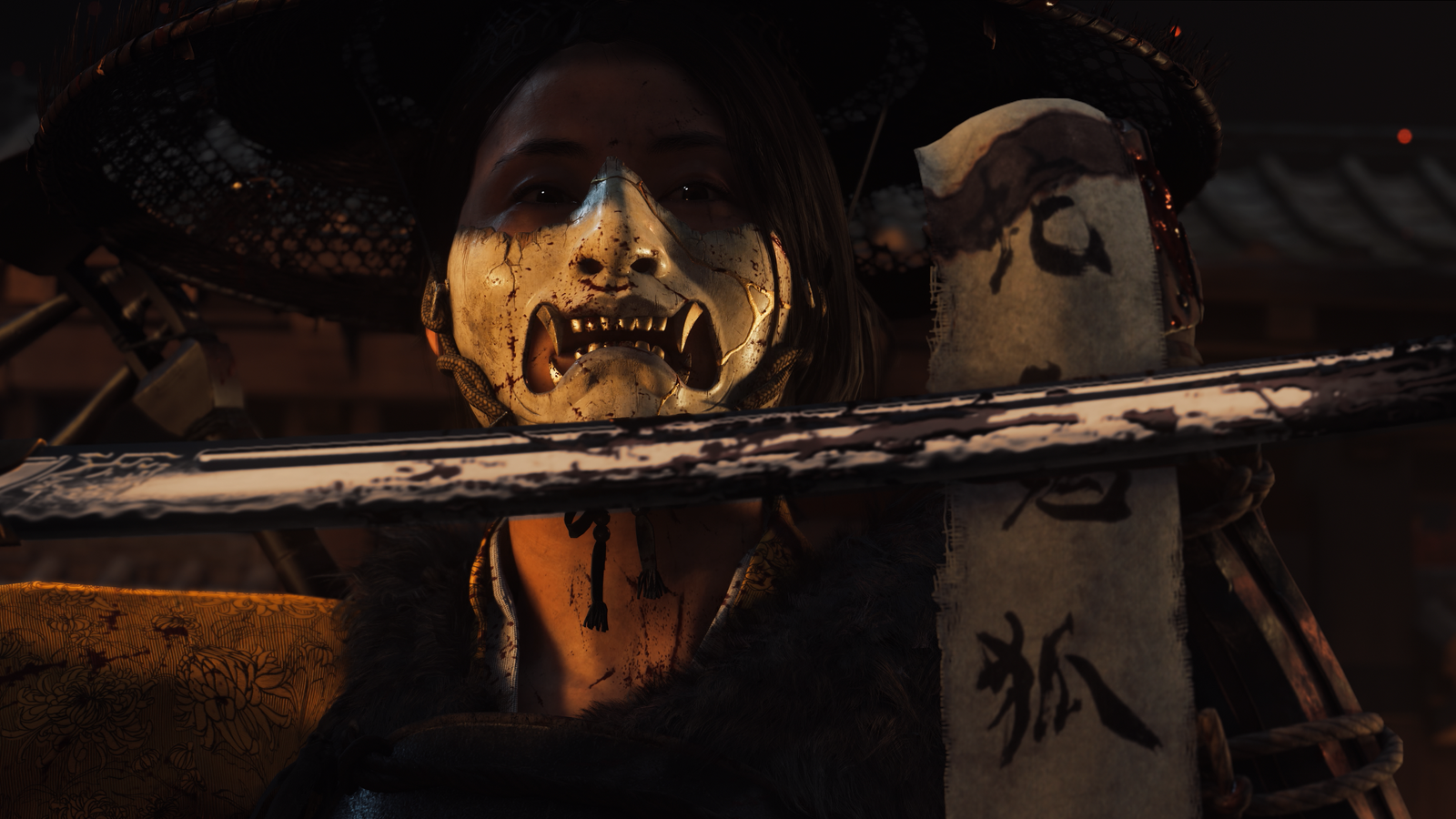
There’s a lot to like about Ghost of Yōtei, but its hero is the literal star of the show. Atsu, voiced by Erika Ishii, is the kind of complicated game character that a sprawling game like Yōtei needs. She’s a tortured woman hell-bent on killing the Yōtei Six, a group of masked killers who murdered her family when she was a child. When we first meet her, she’s so consumed by her quest for bloody vengeance that she believes she too will die once her calling is finished. Atsu changes significantly through her journey, as she slowly finds something new to live for and accepts that there can one day be life beyond grief.
That transformation is one that lives almost exclusively in the samurai sequel’s cutscenes. In Ghost of Yōtei’s moment-to-moment exploration, Atsu is a much flatter character. It’s not a knock on Ishii’s strong performance, but rather a natural byproduct of the open-world genre. How can you keep a character consistently evolving throughout a game when they always must slot back into the status quo at any moment?
In your typical open-world game — and Yōtei is nothing if not typical, much like its predecessor, 2020’s Ghost of Tsushima — there’s no strict order in which you have to tackle content. You can hang onto a sidequest that’s accessible in the very beginning of the game and complete it after you’ve beaten the main story, if you so choose. That’s part of the genre’s appeal; even when the main narrative can only go one way, your own story as a player is organic. No two people are likely to have followed the exact same sequence of shrines and quests in The Legend of Zelda: Tears of the Kingdom.
That construction comes with some tradeoffs. Everything has to be static to a degree, unaffected by how much the story has progressed by that point. Sidequests often live in a bubble, where the NPC that ushers you into them will say the same thing whenever you meet them. And so, your own character also has to be static to a degree. It doesn’t matter what just happened to them minutes before or where they are in their personal journey. It would be impossible, or at least prohibitively expensive, to account for the endless permutations a player can have and create a truly reactive character.
Atsu suffers from that restriction in Yōtei. In the main story, she begins as an almost suicidal woman filled with rage. She’s in a much different place towards the end as she begins to carve out a future for herself. In any given sidequest or optional NPC dialogue outside the critical path, neither end of that spectrum is represented. She always defaults back to a calm state as she patiently hears out quest givers, regardless of what battle she has just survived. It doesn’t detract from the central story, but it does make it harder to follow a consistent emotional journey throughout my playtime.
That thread is present in plenty of open-world games. Atsu isn’t too different from Aloy, the star of PlayStation’s Horizon series. She too has a default state she snaps to even after uncovering a sickening secret deep in Faro’s Tomb. Neither joy nor rage stick with her once a quest is done; it’s all just laid back chatting with the occasional hint of snark. Most recently, I struggled to feel anything towards my Vault Hunter, Harlowe, in Borderlands 4. There’s no sense that she grows or changes in any real way between her quest to lead a revolution. She dishes out the same canned one-liners from start to finish, like a doll with a pullstring. Her dialogue at times just needs to be a thing that fills dead air in a game full of it.


Part of this is just something you come to expect about the odd language of video games over time, though there are notable examples of games that solve for this. Avowed, for instance, leverages the power of choice-driven dialogue systems to create lasting consequences in an ever-changing world. If you decide to go full fascist and help a religious military faction impose authoritarianism on an illness-stricken land, everyone around you will respond to your presence accordingly. But that RPG depth isn’t quite so achievable in Sony’s very structured (and very expensive) brand of open-world game. The tightly directed nature of a game like Yōtei is in conflict with its desire to give players total freedom.
Atsu, as a character, only exists in the broadest strokes on the canvas — the climactic duels with the Yōtei Six, the moments of quiet mourning at her burned down home, the flashbacks to her childhood. She’s a gripping hero in those moments, but she disappears in the interchangeable brush stroke between those scenes. When she’s not getting her revenge, she becomes the vehicle I need to move to get to the next bamboo strike, the next hot spring, the next wolf den. Atsu, like so many other open world heroes, is not always Atsu; sometimes she’s me. And I wouldn’t wish that upon my worst enemies.