

The Big Picture
- Jordan Peele’s career as a director has evolved from sketch comedy to critically acclaimed horror films, starting with the cultural sensation Get Out.
- Get Out was not a pure comedy but incorporated dark humor, horror, and social issues, thanks to Peele’s background in sketch comedy and his creative partner Keegan-Michael Key.
- Peele’s ability to contextualize Eddie Murphy’s joke about horror movies into a story about race in the 2010s is a testament to his comedic and directorial skills, resulting in the success of Get Out.
If you told a viewer of Key & Peele in the early 2010s that one of the titular stars of the sketch comedy series would evolve into an Oscar-winning film director whose films are both critically appreciated and commercial hits, skepticism would reasonably ensue. Of course, this is the story of Jordan Peele, a horror filmmaker who has ascended the heights of the genre itself into prestige cinema. Whenever a new Jordan Peele movie arrives in theaters, it is an event for the entire film community. His career as one of the premiere directors working today began with the cultural sensation, Get Out, which was conceived from a joke by Eddie Murphy thirty years before Peele shaped his vision behind the camera.
Get Out
A young African-American visits his white girlfriend’s parents for the weekend, where his simmering uneasiness about their reception of him eventually reaches a boiling point.
- Release Date
- February 24, 2017
- Runtime
- 103
What Is Jordan Peele’s ‘Get Out’ About?
Get Out follows a young African-American, Chris Washington (Daniel Kaluuya), who learns of the unsettling practices of his white girlfriend Rose Armitage (Allison Williams) and her family on a weekend trip. The film was a cultural sensation, mainly because it is an exquisitely crafted film — a well-oiled machine that integrates clear horror influences while pushing the genre to the next generation. In what came as a bit of a surprise, Get Out was not at all a pure comedy. Instead, he, thanks to his background in sketch comedy with his creative partner, Keegan-Michael Key, sprinkles in dark humor with elements of horror and psychological thrillers, with a confrontational touch of social issues, to create his brilliant directorial debut.
Eddie Murphy Jokes About Horror Movies in His ‘Delirious’ Stand-Up Special
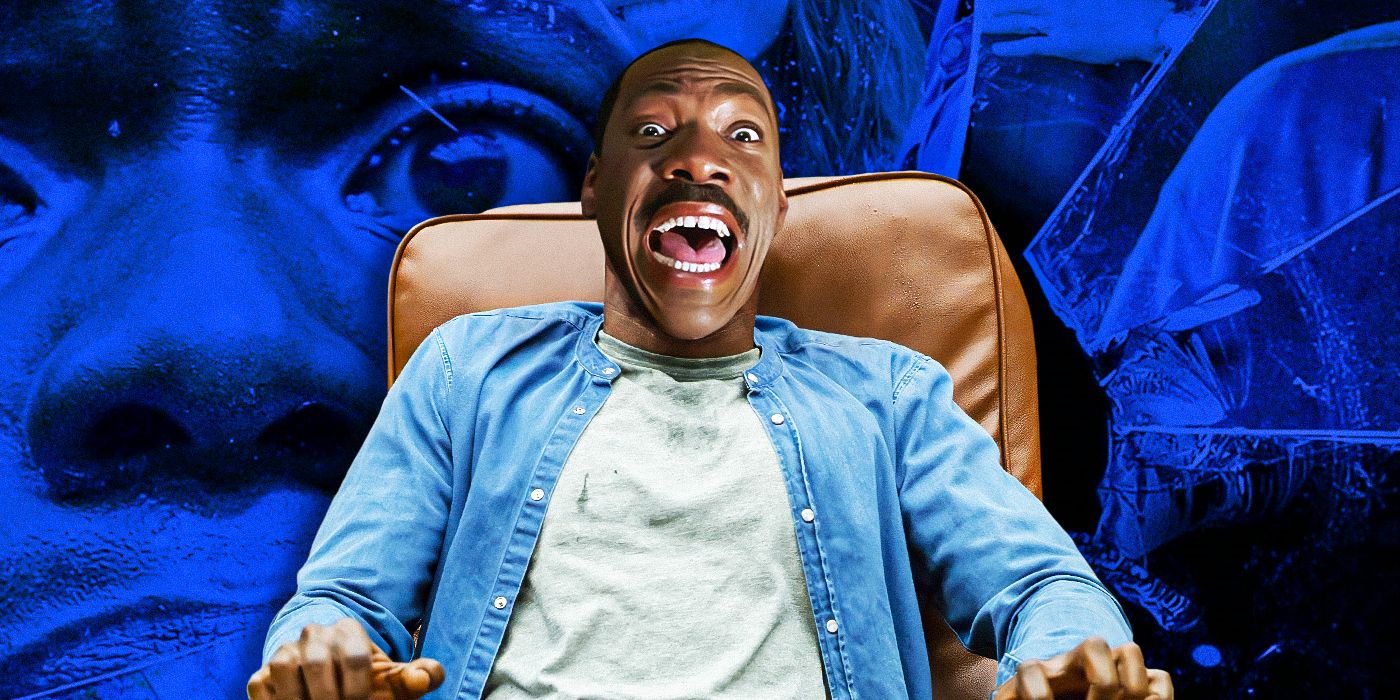
Speaking of a meteoric rise to fame, Eddie Murphy was a movie star, stand-up comic, Saturday Night Live cast member, and SNL host all before he turned 24. At the height of his fame in 1983, Murphy’s raunchy and show-stopping comedy special, Delirious, was released. Among the array of memorable jokes and bits, including the ice cream truck, mishaps at a family barbecue, and a plethora of impressions, one routine inspired Peele’s $250 million grossing film. “Why don’t white people just leave the house when there’s a ghost in the house?” ponders Murphy in the closing moments of his set in Delirious. Referencing contemporary horror films of the period, including Poltergeist and The Amityville Horror, he ridicules the dismissal of logic that is prevalent in films about haunted domiciles. “They invited more white people over,” Murphy continued, while discussing Poltergeist.
Murphy then describes a theoretical scenario where he takes a tour of a house that appears to be comfortable and luxurious, but the moment he suspects ghostly spirits exist within the walls of the property, he will unquestionably flee from the house. Mimicking the voice of a ghost, Murphy yells “GET OUT.” Returning to his normal speaking manner, he responds “Too bad we can’t stay!” Juxtaposing “white people versus Black people” in horror movies has become a recurring trope in stand-up comedy since the release of Delirious. The bit generally expands on Murphy’s observation, that white people try to get to the bottom of supernatural activity while Black people run away to avoid a grisly fate.
While on the red carpet during the premiere of Get Out, Peele confirmed to Entertainment Tonight that the film’s title was an homage to Murphy’s stand-up bit. “It’s one of the best bits of all time,” Peele declared. Considering the writer-director’s rich background in comedy, this should not come as too much of a surprise. An artist like Peele, who emerged from sketch comedy, is required to formulate broad concepts into tightly constructed skits. The genre excels in expanding upon innocuous ideas and extracting unrealized humor in unconventional situations.
Jordan Peele’s Comedy Background Helped His ‘Get Out’ Vision

More so than any sketch comedy series, including SNL‘s forthright satire of U.S. politics through presidential impersonations, Key & Peele was culturally and socially conscious. The show reflected on race relations and ethnic stereotyping in American culture through the apparatus of farce and broad comedy. Peele configuring Murphy’s Delirious bit into a feature film is a progression of his sampling comedic routines with social commentary with Key on television.
Jordan Peele effortlessly transferred his unique comedic voice to the big screen with Get Out. While the 2017 film is not a pure comedy, ignoring Peele’s background in sketch comedy and satire would undermine his trailblazing tonal message. Peele’s ability to contextualize a joke about horror movies by an iconic Black artist into a humorous and sobering story about race in the 2010s is why he is a true auteur. Of course, Get Out is not a literal adaptation of an Eddie Murphy joke. Peele aggressively confronted the country’s racial quandaries of the period — a time that saw the murky transition between the Barack Obama and Donald Trump presidencies. The film was a deeply nuanced genre exercise that reflected the present day, but it reaches its ambitious heights through the comedic lens that shaped its director.

From ‘Get Out’ to ‘Nope,’ Jordan Peele’s Distinct Iconography Is a Visual Feast All His Own
In just three films, Peele has shown a remarkable command of his craft that makes each new film worth seeking out, particularly for their visuals.
The elevator pitch of Get Out is outlandish on paper. “A Black man caught by modern-day slave owners” could be portrayed as a bad parody of a Key & Peele skit. The ingenuity of Get Out is apparent in the film’s tone, which strives for sincerity while simultaneously complementing Peele’s creative acumen. The veneer of innocence of the Armitage family is crucial to the arc of the story, but it is also where much of the humor stems from. Peele pokes fun at the liberal white guilt of the Armitages, such as when Rose’s father, Dean (Bradley Whitford) confesses to Chris that he “would’ve voted for Obama for a third term.” Various microaggressions, such as when one of the Armitage family friends patronizes Chris by glowingly praising Tiger Woods, are embedded to deepen the social commentary and enhance the uncomfortable cringe humor.
‘Get Out’ Is Based on Jordan Peele’s Personal Experience

Peele revealed while sitting down with ET that the blueprint of Get Out was based on a personal experience where he dated a white woman. Just like Chris, he was treated cordially by her family. This felt ominous for him, as he expected a cold reception for being in an interracial relationship. This is why Chris’ friend, Rod (Lil Rel Howery), operates like an audience avatar, as his suspicions that foul play is present within the Armitage estate are validated. Peele manipulates the comic relief character archetype in horror movies to express the doubt of the Armitage family and the presentation of idyllic racial harmony. Peele, along with his debut film, recognizes that society in the current age may be repressing racism, but it certainly has not been eradicated.
Humor is present in all of Jordan Peele’s films. It is seamlessly integrated into stories involving sadistic doppelgängers in Us and fatalistic unidentified flying objects in Nope. It’s only natural that Peele, a comic at heart, would take great inspiration from material by another quick-witted artist, Eddie Murphy. Peele’s experience in sketch comedy helped dissect something grander and exploitable in Murphy’s joke about white people in horror movies. The infusion of ideas within Get Out crystalizes why comedy and horror go hand-in-hand, even if the textual humor is anything but delightful.
Get Out is available to rent on Prime Video in the U.S.

