

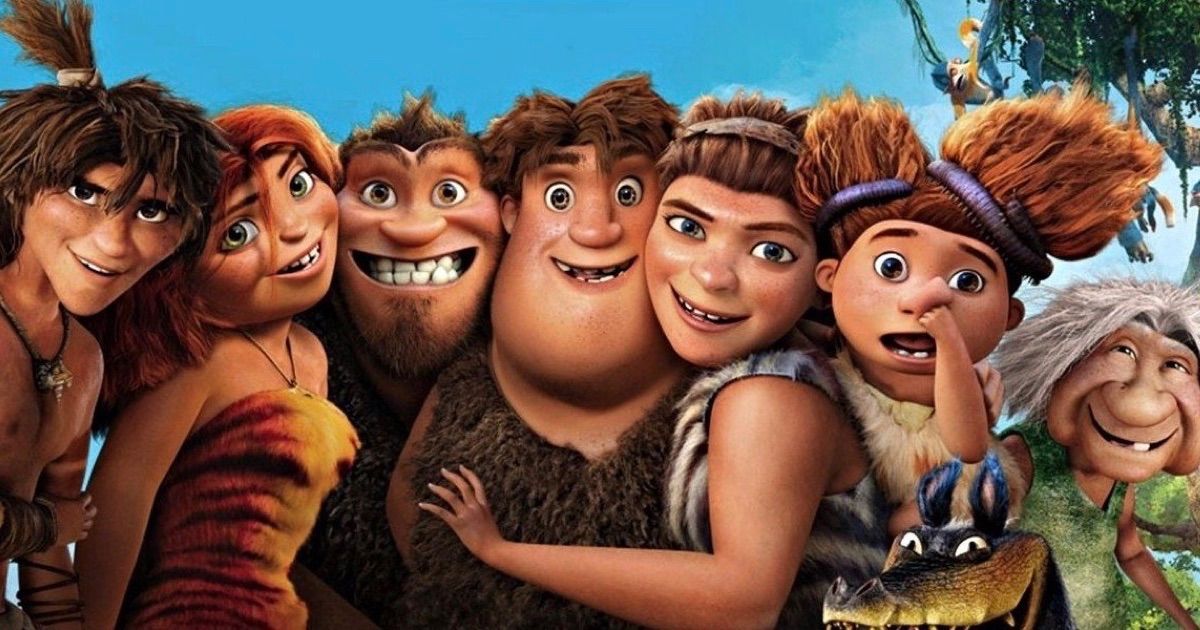
Summary
- The movie The Croods may not be historically accurate, but it successfully weaves a narrative with resonant themes that audiences can relate to.
- While the film portrays a conventional nuclear family, this is not representative of all families universally.
- Despite its inaccuracies, The Croods offers a glimpse into the universality of familial relationships and societal dynamics, highlighting that prehistoric families may not be so different from our own.
As audiences across the globe settled into their theater seats in 2013, they prepared themselves for an animated journey following the escapades of a caveman family in the movie The Croods. Being nominated for Best Animated Feature was just the start; the film birthed a sequel and subsequent series on both Netflix and Hulu. But how accurate was this portrayal of early humans?
Ludovic Slimak, a renowned paleoanthropologist, took to the stage on Penguin Books UK to shed light on this very matter. His evaluation was intriguing. While he acknowledged the film’s blatant historical inaccuracies, Slimak surprisingly applauded the movie for its resonant themes.
It’s not about being a factual record of prehistoric life but instead weaving a narrative that audiences can relate to. Slimak opined, “So it’s very nice because there’s good poetry. The drawings are pretty interesting also. But what we see, it’s a Western family.” He highlights the depiction of a nuclear family, which might be more familiar to audiences in Europe and certain parts of America but is by no means a universal norm.
One may wonder, given Slimak’s expertise, if he’d score the movie low on accuracy. He did, awarding it a mere 2 out of 10 for historical accuracy. However, in terms of its “universal message” and its depiction of the “relation between traditional society and novelty”, Slimak generously rated it a 7 out of 10.
Surprisingly, the highest accolade for accuracy from Slimak went to Stanley Kubrick’s 2001: A Space Odyssey. Still, Slimak found enough depth in The Croods to call it “very interesting” with aspects that were “something true”.
The Croods: Balancing Artistic Liberty with Historical Insight
The movie didn’t set out to be a textbook on prehistoric life. However, the ambiguity of its setting – placing the Crood family in an indefinite prehistoric era without a clear geological timeline – somewhat consolidates the rich tapestry of paleoanthropological history into a singular narrative. The artistic decision has its pros and cons. On one hand, it makes for easy viewing for families looking for light entertainment. Conversely, it paints a rather simplistic picture of ancient human existence.
The film’s portrayal of the Crood family reflects a conventional nuclear family structure, which, while recognizable to many, subtly conveys an enduring nature of this setup. Slimak astutely points out that this isn’t how families universally operate today.
For many viewers, a film like The Croods is a chance to laugh and bond with family, without necessarily dissecting its anthropological accuracies. Slimak nudges us to look beyond the obvious, and upon doing so, a richer narrative unfolds. Animated films might have straightforward plots, but they can also carry nuanced messages.
The Croods might offer a somewhat skewed glance into the past, but it undoubtedly opens a window into the universality of familial relationships and societal dynamics. In Slimak’s words, maybe the prehistoric family in The Croods isn’t so different from our own after all.

