

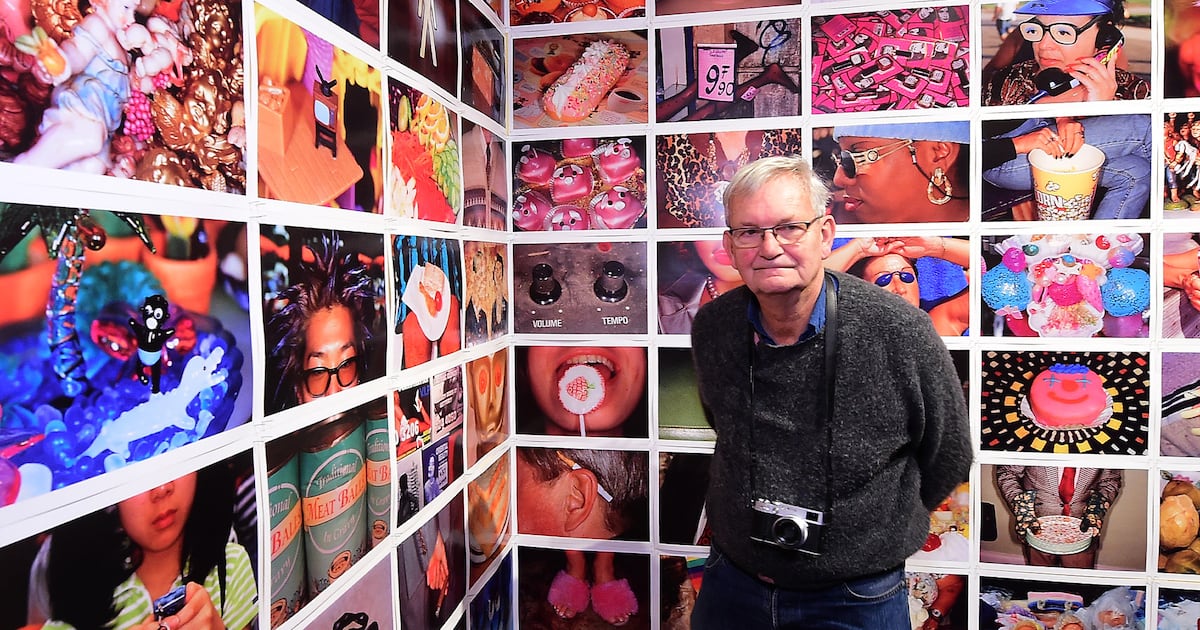
The late Martin Parr was not only a great photographer, but one whose greatness lay precisely in mocking everything that was great, immense and pretentious. It was the reality of the world that he celebrated, making visible the things many try not to see: the vanity fair, global tourism, litter, sunburn. By photographing the mundane, he created work that was unique.
Wherever he was, whether it was shooting the Badminton Horse Trials or a shopping mall in Las Vegas, the first McDonald’s in Russia, tourists in Gambia, or watches bearing the image of Saddam Hussein, he never ceased to be a faithful trainspotter of places, objects and events of all kinds.
People called him kitsch, but he was unclassifiable, a pure outsider, never ceasing to be himself, from Manchester Polytechnic to the Ritz, Paris; from a corridor in the department store Kendale Milne, where he first displayed his work in 1971, to the Jeu de Paume, where a major retrospective titled “Global Warning” is set to open in January, with more than 180 photos.
I met Martin at the end of 2004 through the art director Christophe Renard, when, as a photographer for the Magnum agency, he was working on an exhibition and accompanying “Fashion Magazine” to which I contributed, produced by Le Bon Marché: it featured series such as “Couture Kisses,” “Compensations” and “Lipstick Memories,” with our favourite lipsticks photographed as “traces” on mugs from his personal collection. In a conversation with Paul Smith that ran in the magazine, in which Paul defined British style as “a mixture of classics, tradition, craftsmanship and a hint of eccentricity,” Martin added “ancient and modern combined.” He used to consider irony “the best thing about Britain.”

With Renard, who would later become the art director of Stiletto, the magazine I founded in 2003, we commissioned many fashion stories from Martin. He often set out to create a sense of “incongruity,” the greatest quality of a successful photograph in his eyes. And each time we worked together, it was an extraordinary experience, whether it was for the “Baie des Anges” series in Nice in 2005 with impromptu casting on the beach and models dressed in suits, mingling with vacationers; for “Rebirth” in 2007, an auction organized to benefit Jerusalem’s Hadassah Hospital for which he photographed the lots in a cosmetic surgery clinic; or for “Redux,” another charity project for which various luxury brands created miniature icons that Martin shot at the Plaza Athénée.
He served up life like a commemorative teapot on a plastic tea tray, with perfect manners.
One evening, I invited him to the Cristal Room Baccarat for a Stiletto dinner with William Klein, who paid him no attention whatsoever, as if he didn’t exist. But Martin didn’t care; he always liked to watch while pretending not to exist. It was through his profession that he existed, while giving the impression of resembling an eternal Mr Bean of photography. “Where is your photographer?” an attachée de press once asked me, not realising that Martin was standing in front of her. One of the world’s biggest collectors of photography books (alongside Karl Lagerfeld) looked so unlikely to her with his corduroy trousers, carpenter jacket and old Camper shoes.

He skillfully transitioned from ‘80s social documentarian (The Cost of Living, The Last Resort) to chronicling a world devoured by consumerism. I remember when we asked Martin to shoot swimsuits in 2007, he came back, laughing and happy, with photos full of rolls of fat and potato chips.
Even when you had lunch with him, the world became Martin’s: he would order frogs’ legs and suddenly everything from the red-and-white checked tablecloth to the crumbs on it took on new importance. You saw everything through his eyes. No pretender to ugly chic could ever surpass him.

