

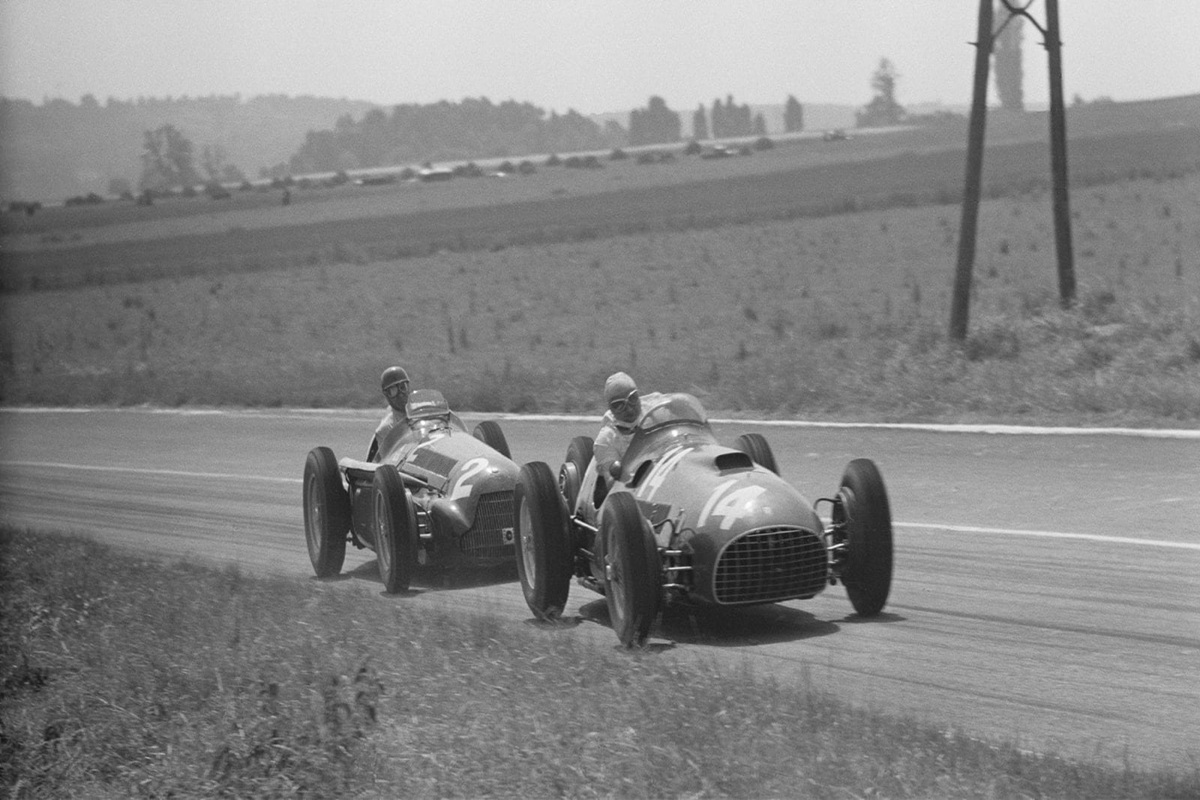
Welcome to a new series here at World in Sport that aims to shine light on the lesser-known champions of Formula One and highlight the greatness of those that we’re more familiar with one by one, starting with Nino Farina.
The very first Formula One World Championship took place in 1950 and looked significantly different to the Formula One that we all know and love today. 75 years ago, the Formula One World Championship consisted of just six races in a short season that saw drivers compete in Britain, Monaco, Switzerland, France, Spain and Italy.
The season saw a drastic demonstration of exemplary Italian engineering through Alfa Romeo’s dominance. The Italian outfit was made up of three drivers: Luigi Fagioli, Juan Manuel Fangio and Giuseppe ‘Nino’ Farina, the man who would go on to win the World Championship. So, let’s take a look at how he did it.
Embed from Getty Images
The British Grand Prix
The inaugural race of the season took place at Silverstone, where King George IV saw Nino Farina secure the first Formula One victory of all time as well as the fastest lap ahead of his Alfa teammates, Luigi Fagioli and Reg Parnell to earn himself all nine points on offer with the Talbot-Lago team taking the final two points-paying positions.
Farina crossed the finish line after two hours and thirteen minutes, completing 70 laps around Silverstone to take victory in the opening race of the Formula One season. The Argentinian ‘Maestro’ Juan Manuel Fangio did not finish the race after having engine troubles, but was able to show his abilities in the next race.
Embed from Getty Images
The Monaco Grand Prix
The Monegasque GP saw the introduction of the famous Italian outfit, Ferrari, headed by Luigi Villoresi, Alberto Ascari and Raymond Sommer. Nino Farina’s teammate, Juan Manuel Fangio, took pole position ahead of Nino Farina and José Froilán González. In 1950, the first five qualifying positions were determined during a Thursday qualifying session, with the front row consisting of three cars.
The rest of the field would then be decided in a Saturday qualifying session, which saw the Ferrari of Luigi Villoresi post a time that was good enough for second place. However, because the top five were decided on Thursday, he only started in sixth place.
The race itself was an eventful one. Windy conditions meant that spray and waves from the harbour fashioned an extremely slippery Tabac corner, leading to a nine-car pile-up on the opening lap. Villoresi, who started sixth, stalled as the pack made way, but incredibly, managed to climb up to second before retiring with a mechanical issue. Villoresi’s teammate, Alberto Ascari, managed to finish second after starting in seventh, giving Ferrari a podium in their first race.
However, it was the pole-sitter Juan Manuel Fangio who won the race after surviving the first-lap chaos. Monegasque driver Louis Chiron took the final podium position after avoiding the chaos on the first lap, making him the only man from Monaco to score points in F1 until Charles Leclerc’s sixth position in the 2018 Azerbaijan GP.
Embed from Getty Images
With both Fangio and Farina managing one win with a fastest lap and one DNF, the Alfa pair sat tied at the top of the championship on nine points, with Fagioli and Ascari level on six, having both managed a second-place finish.
The Swiss Grand Prix
On the same weekend of the Monaco Grand Prix, a race was held at Indianapolis with an all-American line-up. Though none of the European drivers competed, the points from the Indianapolis 500 counted towards the World Drivers’ Championship, meaning that, despite only competing in this one race, the winner, Johnnie Parsons, finished sixth in the championship on nine points.
The third European race was held at Bremgarten in Switzerland, just three weeks after the inaugural race at Silverstone. The Alfa trio of Fangio, Farina and Fagioli secured the top three spots in qualifying ahead of the Ferrari pair of Villoresi and Ascari. The latter managed to keep up with the Alfa Romeo cars on the first lap but was quickly abandoned by the trio.
Fangio led early on but was surpassed by Farina after a quicker refuelling stop. Fagioli was unable to keep up with the pair, but later inherited second place when Fangio retired with an electrical problem, joining the Ferrari trio who had retired earlier in the race. Louis Rosier managed to claim third place from tenth on the grid whilst Nino Farina picked up his second race victory of the season. Farina maintained top spot in the championship on 18 points, whilst another DNF meant Fangio fell to third behind his teammate Fagioli.
Embed from Getty Images
Unfortunately, Luigi Villoresi crashed, resulting in crowd fatalities near the end of the race. There is a lot of speculation about what happened because there is no video evidence. According to the newspaper ‘The Daily News’ in Perth, ‘three spectators were killed, 33 hurt, 13 seriously, when an Italian racing car driven by Luigi Villoresi somersaulted 20ft. into the air, broke in two, ploughed into a crowd near Geneva during the Grand Prix des Nations race yesterday.
Villoresi was rushed to the hospital with head injuries. His condition is not critical.’ Villoresi reported, ‘Nino Farina actually saved my life as he saw me in time to swerve, but he too hit the oil, went off the road and crashed.’
The Belgian Grand Prix
It’s no surprise that the Alfas once again dominated in qualifying, securing all three of the top spots with both Nino Farina and Juan Manuel Fangio posting a lap time of four minutes and 37 seconds. The Alfa trio was followed by the pair of Ferraris, split by Raymond Sommer in a Talbot-Lago. The race followed a familiar path with the Alfas running a race of their own as Sommer battled the two Ferraris.
The Frenchman found himself leading the pack after the Alfa Romeo pitstops, but met a similar fate to three of his fellow teammates and compatriots when his engine blew up, meaning Alberto Ascari inherited the lead of the race. Shortly after, the Italian had to refuel, and order was restored with the three Alfas back in front.
Transmission troubles saw Farina drop to fourth behind the Talbot-Lago of Louis Rosier, who managed his second consecutive podium, with Fangio winning the race ahead of Fagioli in second. The result meant that Fagioli moved within four points of Farina and Fangio within five, with just two races left.
Embed from Getty Images
The French Grand Prix
The penultimate race of the season was held at Reims-Gueux, a race in which Farina would lose the championship lead for the first time, with just one race to go. Once again, the trio of Fangio, Ferina and Fagioli secured the front row in that order, followed by three Talbot-Lagos. Farina initially led the race but fell to the back of the grid due to a fuel pump issue.
The Italian fought back to third place behind his Alfa teammates before being forced into retirement, leaving the door open for Fangio or Fagioli to take the lead of the championship. It was Fangio who took advantage of the mechanical malfunction, securing the fastest lap and finishing 25 seconds ahead of Fagioli to take all nine points.
Peter Whitehead, the sole competing Ferrari driver, managed to climb to the final podium position from nineteenth on the grid. With Nino Farina’s DNF, Juan Manuel Fangio moved up to first place in the championship on 26 points, followed by Luigi Fagioli on 24 and Farina on 22 heading into the final race.
Embed from Getty Images
The Italian Grand Prix – The Finale
The title looked all but sealed for Fangio. If he finished first or second, he won. If he finished third, fourth or fifth and Farina didn’t finish first, he won. With the speed of the Alfa Romeo, if Fangio finished, it would more than likely be in the top three.
Fangio qualified first, proving his worth as victor over his teammates, who only managed third and fifth. Alfa added two more racers to their roster for the final race, whilst Ferrari brought an upgraded engine to try and put a stop to the Alfa Romeo’s domination, an engine that allowed Alberto Ascari to qualify within two tenths of Juan Manuel Fangio.
However, the new engine overheated just 21 laps into the race, forcing the Italian to retire. Soon after, Fangio followed with a gearbox issue, meaning that whichever Alfa Romeo won the race would win the championship. In the end, it was Nino Farina who took the victory ahead of the Ferrari of Dorino Serafini, which Ascari drove for the second half of the race.
The victory saw Nino Farina take the first-ever World Drivers’ Championship, three points ahead of Juan Manuel Fangio, for what would be the Italian’s only ever world championship.
That’s the story of how Nino Farina won his first and only World Drivers’ Championship. Keep an eye out for the second instalment of this brand new series coming next week, where we’ll take a look at how Juan Manuel Fangio secured his first WDC.
👉 Related: Top 10 Richest F1 Drivers in the World


