

Key Takeaways About Volcanic Activity On Mars
- Volcanic activity on Mars has existed in the past. The most recent was likely 50,000 years ago.
- Olympus Mons, the largest volcano on Mars, hasn’t shown signs of activity for 25 million years.
- Volcanic activity on Mars — and on Earth — likely helped provide elements like oxygen and hydrogen to the atmosphere, which are key ingredients for life.
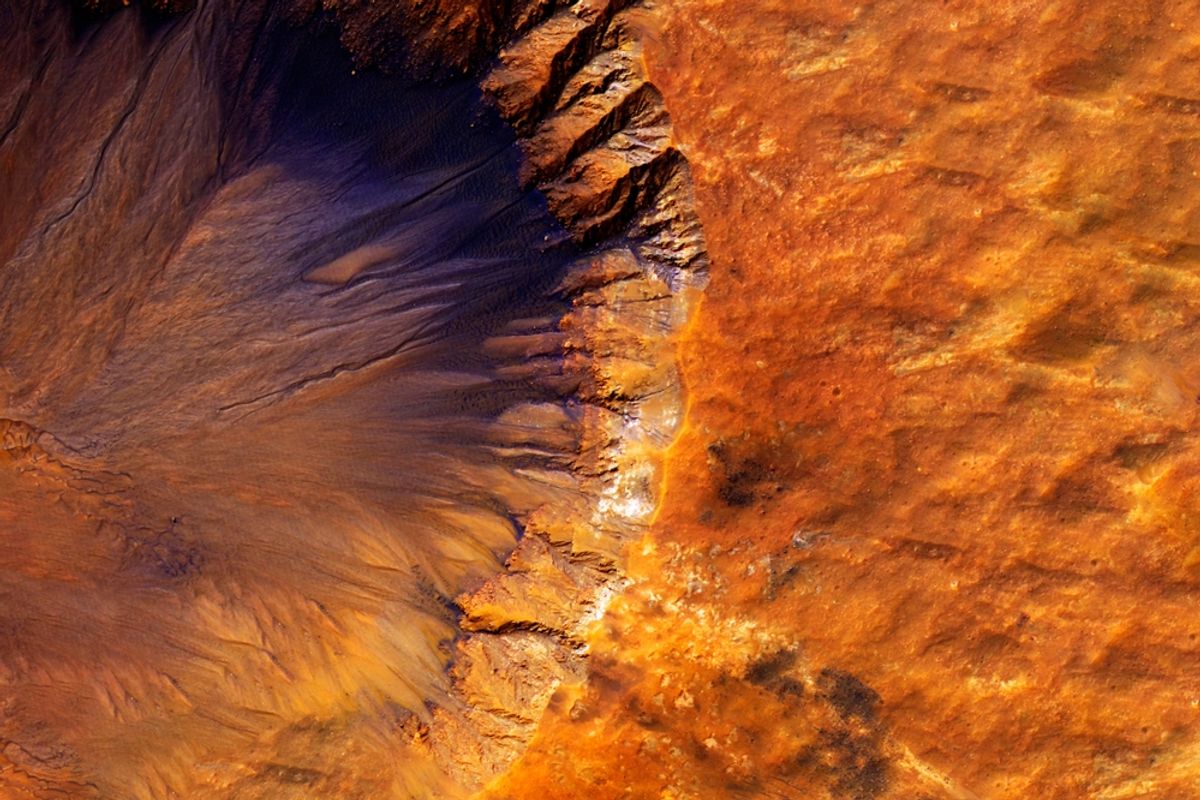
Mars is and has always been a very volcanic planet. In the modern era, Mars’ volcanism has been concentrated in certain areas, namely the Elysium and Tharsis regions, but at one time it was spread all over the planet. Surface evidence shows that there has long been volcanism on Mars from its start, and some researchers contend that it may be ongoing.
“Some of the biggest volcanoes in our solar system exist on Mars. In fact, the biggest mountain in our solar system, Olympus Mons, is a giant volcano,” says geologist and planetary scientist Cory M. Hughes.
To provide some perspective, Olympus Mons is about 2.5 times the size of Mount Everest. But although this monster mountain could put on a volcanic show, it hasn’t erupted for 25 million years. Still, we know that it can and that it once did.
Read More: First Evidence of a Recently Active Volcano on Mars
Volcanic Activity on Mars
By some accounts, there may have been volcanism on Mars as recently as 50,000 years ago, which, geologically speaking, is like the blink of an eye.
Researchers typically use something called crater density counting to age volcanism on rocky planets. Using rocks from the surface of the moon, scientists can measure how many craters there were at different points in the history of our solar system. By counting the number of craters and the density and size of them on Mars, researchers can place the age of that surface based on what we know about our moon, says Hughes.
Additionally, researchers use spectroscopy, or light that bounces off the planet, to identify the materials found on Mars.
“The way the light bounces off the surface, and the specific wavelengths and unique absorption figures can help researchers identify volcanic signatures,” says Hughes.
By combining these two techniques, crater density counting and spectroscopy, scientists can age the lava back to a certain time period to know when the last eruptions occurred.
Why Volcanic Activity Matters on Earth and Mars
Early volcanism matters because we know that on Earth, it may have provided the atmosphere with essential elements like oxygen and hydrogen, which almost all living beings need for survival.
“Volcanoes spit out lots of rock, but they also spit out lots of gas,” says Hughes. “Volcanism is a mechanism for taking volatiles from deep within the planetary interior and launching them into the atmosphere.”
In some cases, this can make the planet unlivable, as it did on Venus, a planet where runaway greenhouse gases cause the temperature to be the hottest in the solar system at 700 degrees Celsius, according to the European Planetary Society. But in other cases, volcanism can provide the building blocks for life on Earth. This means that volcanism provides a clue in the search for life on other planets.
Volcanic Activity on Mars Could Have Helped Life Thrive
Additionally, the cores of Earth and Mars are also quite similar, providing evidence that Mars was once home to life. The difference between Earth and Mars is that Earth has plate tectonics, which moves around, causing earthquakes and eruptions that recycle rock from the core to the surface. But this isn’t the case on Mars.
That’s why Earth has granite on its surface, and Mars doesn’t, because you need subduction to have granite. However, both planets are covered in basalt, a form of slow-moving lava that’s also a sign of ancient volcanism.
Researchers have long been looking for life on Mars, more specifically for signs of water that exists or ever existed. In the early history of the planet, 3.7 billion years ago, Mars was home to abundant water, with precipitation cycles that included snow, rain, large lakes, rivers, and potentially an ocean in the planet’s northern hemisphere, according to NASA. All life on Earth requires water, so when it comes to Mars, we’re always “following the water.”
For geologists, volcanism provides the elements that could mean life on other planets.
“We have good indications that at one time Mars was habitable, but whether or not there was life on the planet is another story,” says Hughes.
Read More: Wave Ripples Prove the Existence of Ice-Free Lakes on Ancient Mars
Article Sources
Our writers at Discovermagazine.com use peer-reviewed studies and high-quality sources for our articles, and our editors review for scientific accuracy and editorial standards. Review the sources used below for this article:

