

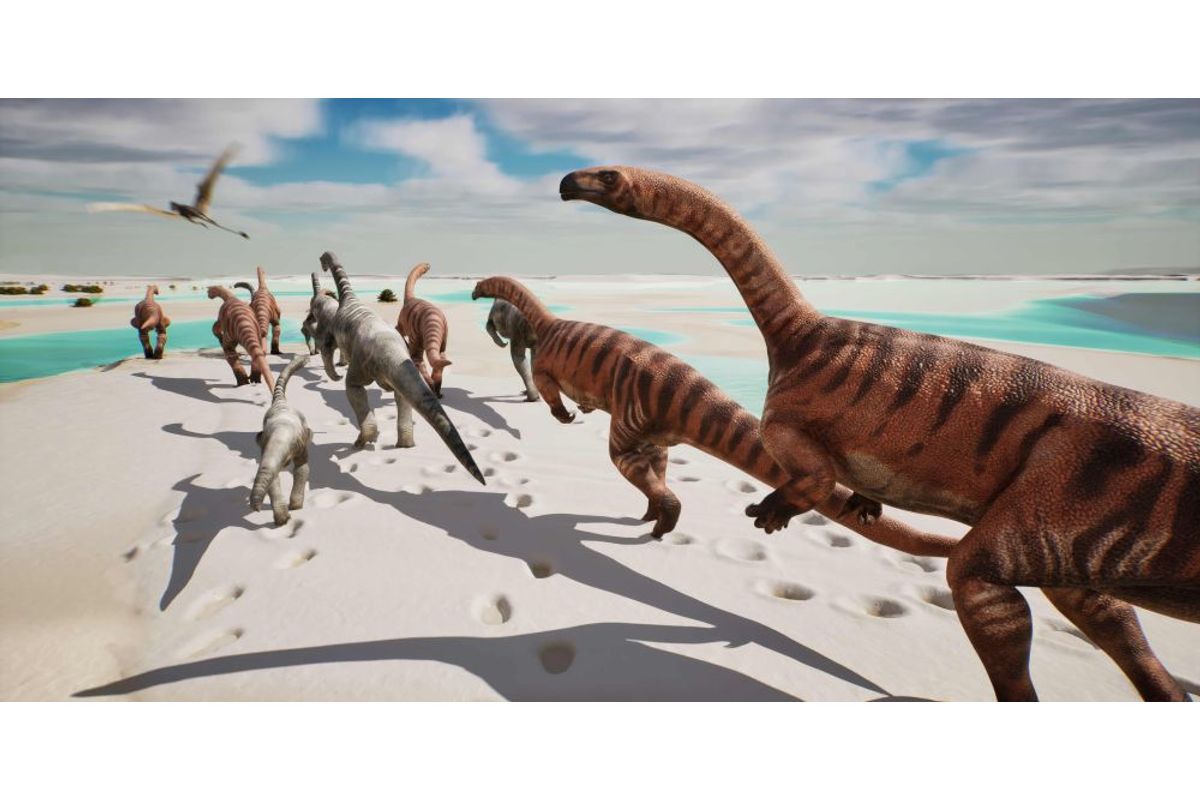
Next year, Northern Italy will host the 2026 Winter Olympics. But the region has made headlines six weeks early, as regional authorities announced the discovery of a well-preserved trail of dinosaur footprints.
Attilio Fontana, head of the Lombardy region, called the footprint find “one of the largest collections in all of Europe, in the whole world,” in a recent press conference.
Read More: Duck-Billed Dinos Broke Their Mates’ Tails, Exposing Dinosaur Sex and Sexual Difference
Footprints on the Side of a Mountain
(Image Credit: Elio Della Ferrera. PaleoStelvio Arch. (PNS, MSNM, SABAP CO-LC).)
Photographer Elio Della Ferrera was exploring the scenic Stelvio National Park in September 2025 when he spotted the tracks on the side of a nearly vertical rocky outcrop. The prints, which stretched for hundreds of yards, contained identifying features, like toes and claws. Some were up to 16 inches in diameter.
Fontana said the print trail “extends for hundreds of meters and also represents a series of animal behaviors, because in addition to seeing animals walking together, there are also places where these animals meet.”
Soon after Ferrera’s find, a team of Italian paleontologists descended on the park to study the prints in more detail. Cristiano Dal Sasso, a paleontologist at Milan’s Natural History Museum, called the findings an “immense scientific heritage.”
“The parallel walks are clear evidence of herds moving in synchrony, and there are also traces of more complex behaviors, such as groups of animals gathered in a circle, perhaps for defense,” Dal Sasso added.
The researchers can easily date their new finding, as the rock in which the tracks are imprinted is 210-million-year-old Upper Triassic dolomitic rocks. The prints appear to have been made by two-legged animals, some with at least four toes.
Brontosaurus’s Ancestors and Ancient Crocodiles
The experts have proposed that the prints belong to herbivorous dinosaurs called prosauropods. These animals are thought to be ancestors of huge Jurassic sauropods like the Brontosaurus. They shared the Brontosaurus’s small head and long neck and could have been up to 33 feet long.
Not all of the prints belonged to sedate leaf-eaters. Some appeared to have been left by predator dinosaurs. Archosaurs, the ancient predecessors of modern-day crocodiles, may have made some of the other prints, the experts suggested.
When the dinosaurs made their tracks, they would have been strolling across flat tidal plains in a tropical environment. Since then, the world has changed a bit, and the Alps have emerged, turning the flat ground into the nearly vertical face of a mountain.
“The tracks were made when the sediments were still soft and saturated with water, on the broad tidal flats surrounding the Tethys Ocean,” said fossil expert Fabio Massimo Petti. The Tethys Ocean was a massive prehistoric body of water that has now become the Indian Ocean, the Mediterranean Sea, and the inland lakes of the Black and Caspian Seas.
The mud bordering the sea was later transformed into rock, which preserved the embedded prints. Subsequent erosion of the now mountainside has once again revealed the prints to the world. The findings have been reported at the end of a rich year for dinosaur discoveries, which included 115-million-year-old prints revealed by Texas floodwaters, a massive chain of 16,000 prints spread across a national park in Bolivia, and a “dinosaur highway” revealed in an English limestone quarry.
Read More: Footprints From Around 150 Million Years Ago Reveal the Strange Stomp of a Looping Sauropod
Article Sources
Our writers at Discovermagazine.com use peer-reviewed studies and high-quality sources for our articles, and our editors review for scientific accuracy and editorial standards. Review the sources used below for this article:

