

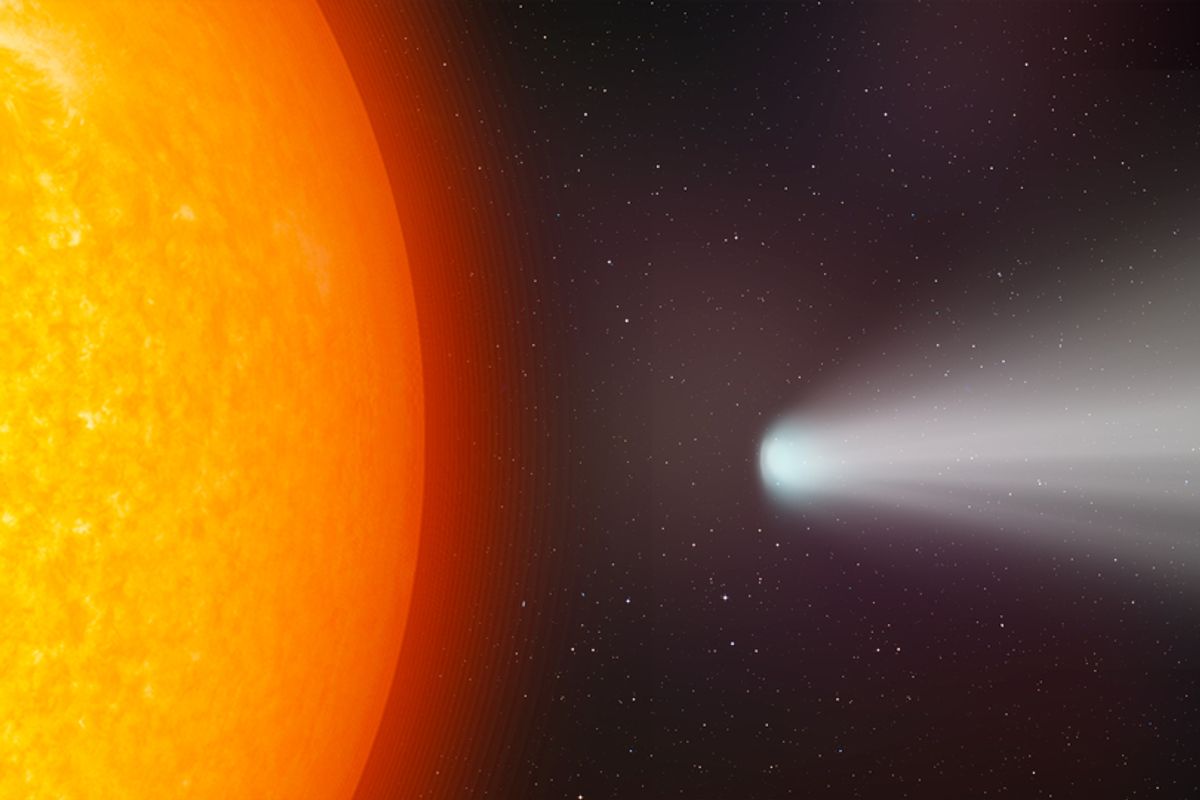
New images of the other ATLAS comet show that it has fragmented as it continues its journey following its visit to the sun last month.
The observations were made by The Virtual Telescope Project 2.0 last week and follow evidence of two outbursts reported in The Astronomer’s Telegram. The Italian astronomer Gianluca Masi posted an update on Nov. 11 with an image of C/2025 K1 (ATLAS) and “its ‘double’ nucleus.”
According to Masi, the second nucleus may be “a cloud of debris.” Also visible in the picture is a “spike-like feature” that points to the direction of the sun.
Updates posted in the following days show this “spike-like feature” getting stronger. Additional clouds of debris can also be seen in the images.
On Nov. 14, Masi notes, “Several parts (sub-nuclei or clouds of debris) are still visible, with an interesting arc-like feature on the left, in the solar direction.”
C/2025 K1 (ATLAS) Flying Too Close To The Sun
The C/2025 K1 (ATLAS) was identified in May this year by astronomers involved in the “Asteroid Terrestrial-Impact Last Alert System” (ATLAS).
The comet reached its perihelion — the point in its orbit closest to the sun — on Oct. 8, when it came within 0.335 astronomical units (AU) or 31,180,206 miles of the star, according to The Sky Live. It can now be seen passing through the constellation Ursa Major and will reach its closest approach to Earth later this month, on Nov. 25, when it will appear at a distance of 0.403 AU (37,488,865 kilometers) from the planet.
Astronomers were unsure whether C/2025 K1 (ATLAS) would survive its drive-by the sun. Passing within such a short distance of the sun would have caused temperatures to ramp up, producing conditions that could cause a fragmentation event.
But while it appeared to have withstood the initial passage, these latest images suggest it did not make it out in one piece for long. According to The Astronomer’s Telegram, Las Cumbres Observatory (LCO) and Zwicky Transient Facility (ZTF) in California observed two “apparent” outbursts — sudden changes in brightness — between Oct. 31 and Nov. 4.
On November 10, an instant email notice published on The Astronomer’s Telegram reported “two leading fragments…with the second fragment appearing noticeably brighter than the first.” There were also “two additional fainter fragments…visible farther along the same orientation.”
C/2025 K1 (ATLAS): The Color Changing Comet
C/2025 K1 (ATLAS) has been dazzling astronomers and stargazers for months, as have two other comets lighting up the night skies — C/2025 R2 SWAN and C/2025 A6 (Lemmon).
Images taken by NASA in September appear to show the comets racing, though this is purely a coincidence. (C/2025 R2 SWAN had already reached its perihelion and was heading outbound, while C/2025 K1 (ATLAS) was yet to reach its perihelion and was travelling inbound at the time the picture was taken.) Also notable is the striking emerald hue emitted by both comets. The greenish tint can be the result of a reaction between diatomic carbon molecules (C2) and light.
But like a celestial chameleon, C/2025 K1 (ATLAS) has changed colour, transforming from green to gold in more recent weeks.
While the comet may not have made its journey to and from the sun fully intact, its fragmentation may offer astronomers the chance to explore its composition in more detail, Elena Mazzotta Epifani, research astronomer at the Italian National Institute for Astrophysics (INAF) Rome Astronomical Observatory, said in a translated statement.
Read More: Radio Signals Detected From Comet 3I/ATLAS — What Its Interstellar Origins Reveal
Article Sources
Our writers at Discovermagazine.com use peer-reviewed studies and high-quality sources for our articles, and our editors review for scientific accuracy and editorial standards. Review the sources used below for this article:
- This article references information from the Virtual Telescope Project, Comet C/2025 K1 ATLAS fragmentation: 10 & 11 Nov. 2025 images
- This article references information from the Virtual Telescope Project, Comet C/2025 K1 ATLAS fragmentation: 12 Nov. 2025 image
- This article references information from the Virtual Telescope Project, Comet C/2025 K1 ATLAS fragmentation: 13 Nov. 2025 image and animation
- This article references information from the Virtual Telescope Project, Comet C/2025 K1 ATLAS fragmentation: new image – 14 Nov. 2025
- This article references information from NASA, Astronomy Picture of the Day
- This article references information from NASA, Astronomy Picture of the Day
- This article references information from the Astronomer’s Telegram, Apparent Outbursts of Comet C/2025 K1 (ATLAS)
- This article references information from the Astronomer’s Telegram, Fragmentation of C/2025 K1 (ATLAS)
- This article references information from the Astrophysics Data System, Comet C/2025 k1 (atlas)
- This article references information from a study published in the journal PNAS, Photodissociation of dicarbon: How nature breaks an unusual multiple bond

