

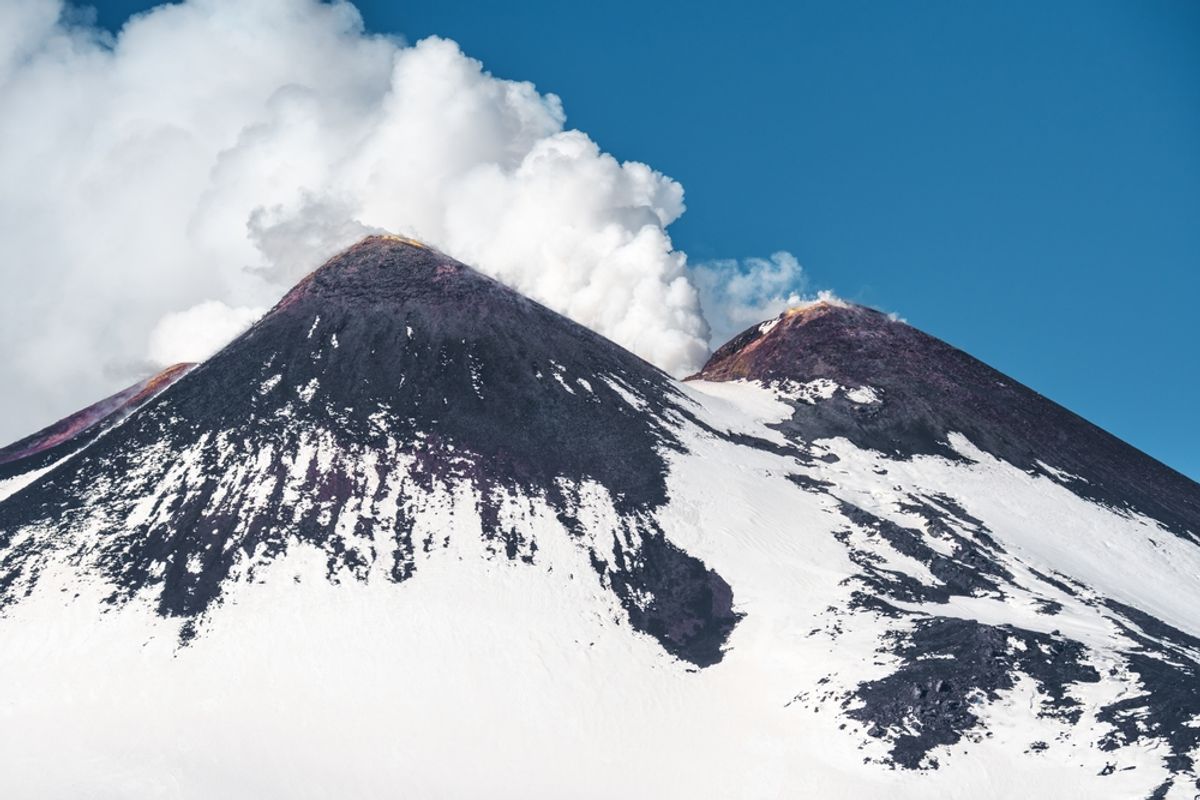
On Christmas Eve 2025, deep within Sicily’s Mount Etna, it started to rumble again. Although Mount Etna is one of the most active volcanoes in the world, showing activity throughout the year, one of its main craters on the Northeast side finally awoke after almost 30 years of dormancy.
According to the National Institute of Geophysics and Volcanology (INGV), volcanic activity had been elevated for several weeks. However, on December 24, 2025, several monitored signals, including volcanic tremors, ground deformations, and infrasonic activity, began to peak.
Shortly after, the Northeast Crater started spewing fiery material, reawakening after decades of inactivity.
Mount Etna Crater Awakens After 30 Years
Over the course of several days, most of Mount Etna’s summit craters — Bocca Nuova, Voragine, and Northeast — emitted modest amounts of volcanic ash, accompanied by strong but sporadic Strombolian explosions. This led to ash fallout at Piano Provenzana and Taormina, with plumes rising as high as five miles above sea level.
Notably, the Northeast Crater ejected coarse pyroclastic material more than 300 feet high, spreading across the entire cone and well beyond its base. It also produced a continuous lava fountain several tens of meters high, according to an INGV press release. Meanwhile, the Voragine Crater generated a lava flow heading eastward, reaching over a mile in length.
Read More: Some Volcanoes Don’t Explode When Erupting — A Hidden Force Helps Pressure to Escape
Europe’s Most Active Volcano
Mount Etna, at the tip of Italy’s “boot,” is one of the most active volcanoes in the world and the most active in Europe, standing more than two and a half times taller than Mount Vesuvius.
Since volcanoes can significantly change their morphology after major eruptions, Mount Etna’s height varies, currently rising around 10,900 feet above sea level. Covered in snow, it is also a popular tourist destination, with two ski resorts on its slopes.
According to Britannica, the volcano began rumbling around 2.6 million years ago, at the end of the Neogene Period, a time known for significant tectonic shifts. Ancient Greek legends explained Etna’s violent activity as either the workshop of Hephaestus, god of fire and metalwork, or the presence of buried giants moving the mountain. Mount Etna’s name likely derives from the Greek aíthō, meaning “I burn.”
Etna’s Activity Impacts Tourism and Air Traffic
2025 has been a vital year for Mount Etna. Since February, there have been three distinct eruptive phases, each with different activity “styles,” making them highly interesting for volcanologists. For instance, a major eruption in June sent plumes up to 21,000 feet, disrupting local air traffic and tourist activities, according to Boris Behncke, a volcanologist at INGV in Catania.
The current eruption also prompted a red flight alert, the highest warning level, but it hasn’t fully impacted operations at Catania’s international airport, Italy’s leading national news agency Ansa reported. Despite the drop of activity yesterday, local authorities continue to urge residents to stay informed about ongoing developments.
Article Sources
Our writers at Discovermagazine.com use peer-reviewed studies and high-quality sources for our articles, and our editors review for scientific accuracy and editorial standards. Review the sources used below for this article:

