

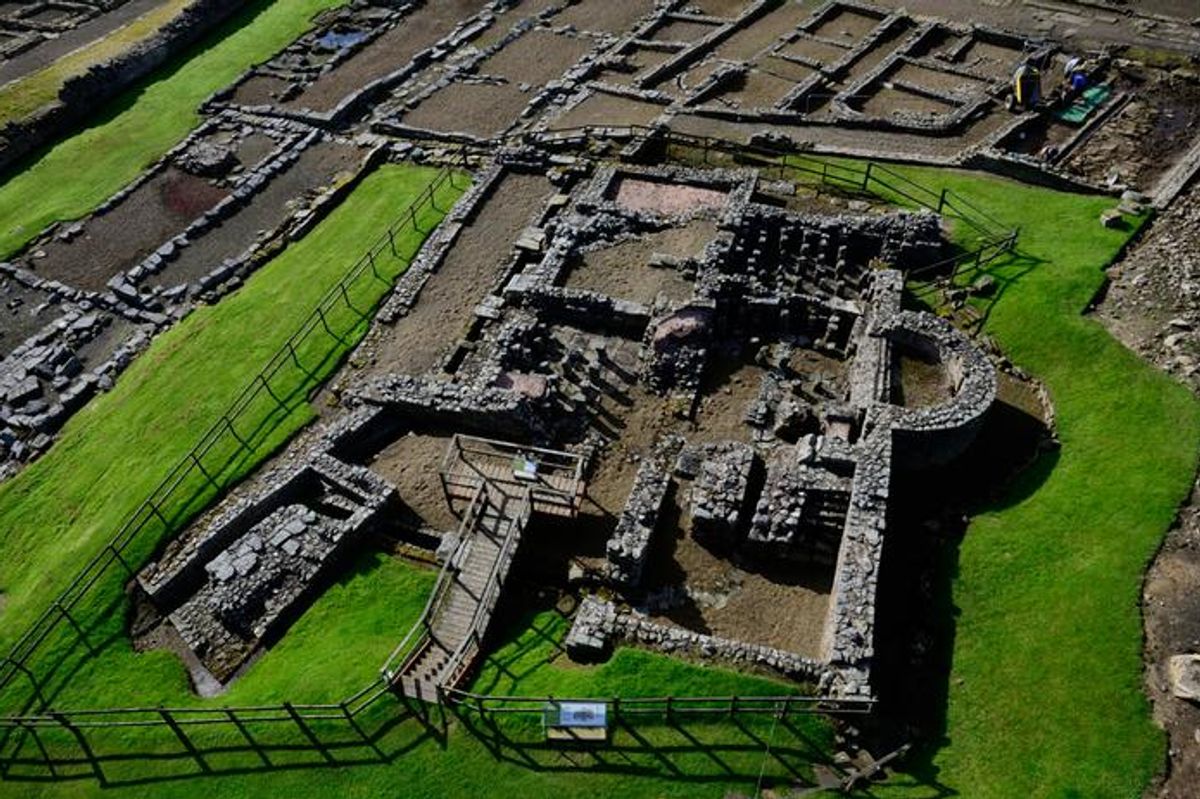
Long after Roman soldiers left Vindolanda, the fort’s sewer system kept a record of what plagued them most. Hidden in the sediment were parasites that reveal how disease spread through daily life near Hadrian’s Wall.
Researchers examining an ancient sewer drain at Vindolanda, a Roman fort near Hadrian’s Wall in northern England, found evidence that its occupants were infected with multiple intestinal parasites. The analysis uncovered eggs from roundworm and whipworm, along with traces of Giardia duodenalis — a finding that adds a new parasite to the record of Roman Britain. Published in the journal Parasitology, the study offers insight into how disease circulated through a Roman military community.
“We suspected that parasites such as roundworm and whipworm, spread by poor sanitation, might be present at a fort at the edge of the empire. However, finding Giardia was a really exciting find, as until now in the Roman period it has only been found in Turkey and Italy,” says senior study author Dr. Piers Mitchell.
Vindolanda’s Sewers Reveal Daily Roman Life
Vindolanda is one of the best-preserved Roman military sites in Britain, thanks to waterlogged soil that has protected organic material for centuries. Excavations have uncovered everything from ink-written wooden tablets detailing daily life to thousands of leather shoes.
That same preservation extends beyond personal belongings. Vindolanda’s infrastructure — including parts of its sanitation system — has also survived in good condition. In this new study, researchers analyzed material from a nine meter sewer drain connected to a communal latrine at a third-century C.E. bath complex.
“Despite the fact that Vindolanda had communal latrines and a sewer system, this still did not protect the soldiers from infecting each other with these parasites,” said Dr. Patrik Flammer, of the University of Oxford, in a press release.
Located in what is now Northumberland, between modern-day Carlisle and Corbridge, the fort housed infantry and cavalry units tasked with defending Rome’s northern territory, and later sat just south of the line of Hadrian’s Wall, which was built in the early second century C.E.
Read More: An 800-Year-Old Design Reveals a Lost Trojan Tale in a Roman Mosaic
Parasites in Ancient Sewers
Parasite remains appeared throughout the sewer drain, suggesting infections were not isolated cases. About 28 percent of the samples contained eggs from roundworm or whipworm, parasites that spread through contact with contaminated food, water, or hands.
Whipworm egg from analysis of sediment from the sewer drain from bath complex at Vindolanda.
(Image Credit: Marissa Ledger)
Evidence of infection also turned up in an older part of the site. Researchers analyzed a sample from a ditch associated with an earlier first-century C.E. fort at Vindolanda — constructed around 85 C.E. and abandoned just a few years later — and found both roundworm and whipworm eggs there as well. The finding suggests that intestinal parasites were already circulating among soldiers at the site decades before the later bath complex was built.
One sewer sample containing both worm species was examined further using ELISA, a biomolecular technique that detects proteins produced by single-celled organisms. That test identified G. duodenalis, a microscopic parasite that causes giardiasis — an illness marked by prolonged diarrhoea, fatigue, and weight loss.
Roman physicians knew that intestinal worms existed, but they had little ability to treat them effectively. As a result, infections could persist and worsen over time. Outbreaks of giardiasis — often linked to contaminated water — may have been especially dangerous during warmer months, when dehydration could leave soldiers severely weakened.
What Ancient Parasites Teach Us
The findings raise new questions about how intestinal parasites spread across ancient Europe.
“It would be great to study a range of Neolithic, Bronze Age and Iron Age sites across northern Europe to see if Giardia was present there too, or if it was absent before the Romans but introduced to new regions around the empire by their soldiers or merchants,” Mitchell says.
Beyond future research, the parasites preserved in Vindolanda’s sewers offer a sobering glimpse into daily life on Rome’s frontier.
Read More: Ancient Romans Gave Tiny Bronze Skeletons to Party Guests As a Morbid Reminder to Live Life
Article Sources
Our writers at Discovermagazine.com use peer-reviewed studies and high-quality sources for our articles, and our editors review for scientific accuracy and editorial standards. Review the sources used below for this article:

