

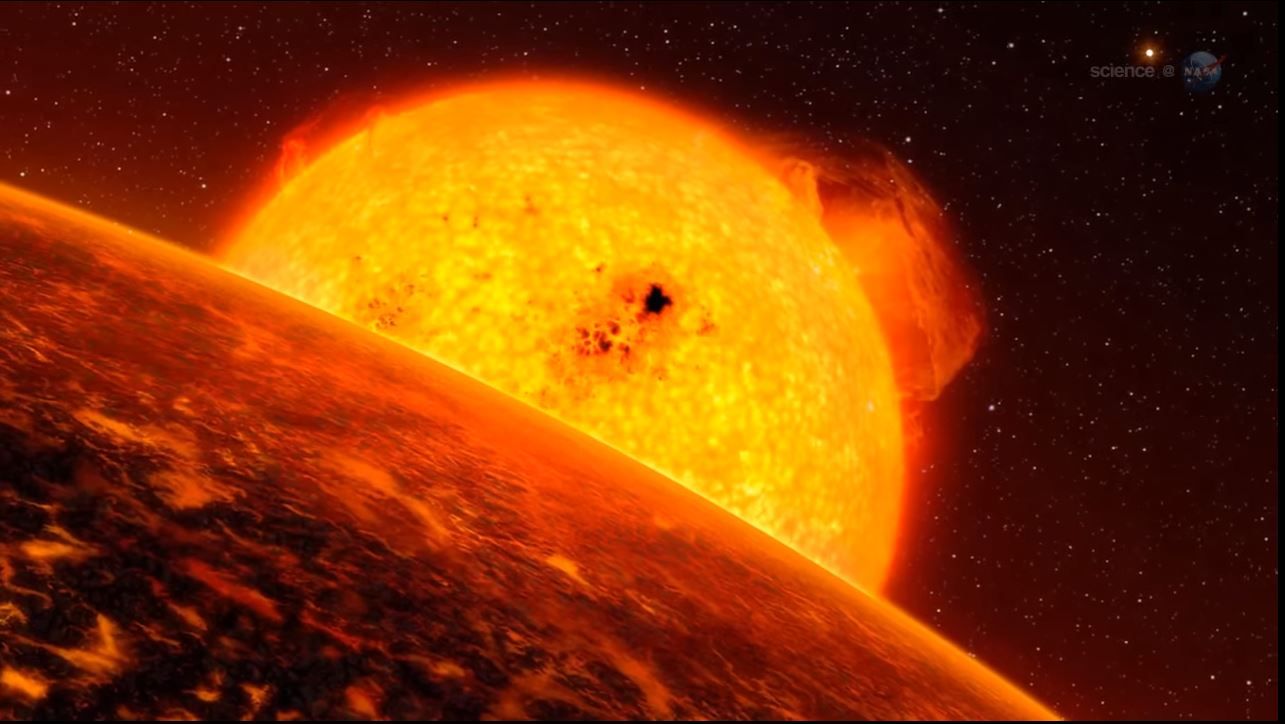
Using NASA’s Transiting Exoplanet Survey Satellite (TESS), astronomers have discovered that aging stars in their so-called “red giant” phase are even more destructive to their orbiting planets than previously suspected. What does this tell us about what will happen to Earth and the rest of our solar system when the sun undergoes this violent transformation?
Scientists use TESS to hunt for extrasolar planets, or “exoplanets,” by observing the dips in starlight they cause as they cross or “transit” the face of their star from its viewing angle around Earth. Beginning with almost half a million planetary systems, a team of researchers worked this down to a sample of 15,000 possible planetary signals detected by TESS. The team then applied a computer algorithm that helped them identify only those planet candidates that orbit stars just beginning to become red giants, finding the number to be around 130, including 33 that were new candidates detected for the first time.
“This is strong evidence that as stars evolve off their main sequence, they can quickly cause planets to spiral into them and be destroyed. This has been the subject of debate and theory for some time, but now we can see the impact of this directly and measure it at the level of a large population of stars,” Edward Bryant, team member and University of Warwick researcher, said in a statement. “We expected to see this effect, but we were still surprised by just how efficient these stars seem to be at engulfing their close planets.”
Stars make an extreme makeover
Stars become red giants when they reach the end of the hydrogen in their cores, meaning this lightest element can’t continue to be converted into helium, the nuclear process known as fusion that powers so-called “main sequence” stars like the sun. When this happens, the cores of these stars start to contract, but the outer layers, where hydrogen is still transformed to helium, “puff out,” causing the star to expand to as much as 1,000 times its original size. That marks the end of the main sequence phase and the beginning of the red giant stage of a star’s life.
Obviously, this is bad news for the planets orbiting close to this transforming star. For example, when the sun enters its red giant phase in around 5 billion years, it will expand to swallow Mercury and Venus, and possibly even our own planet. However, this isn’t the only method of destruction that this team thinks stars employ as red giants.
“We think the destruction happens because of the gravitational tug-of-war between the planet and the star, called tidal interaction. As the star evolves and expands, this interaction becomes stronger,” Bryant continued. “Just like the moon pulls on Earth’s oceans to create tides, the planet pulls on the star. These interactions slow the planet down and cause its orbit to shrink, making it spiral inwards until it either breaks apart or falls into the star.”
This is reflected by the fact that when the team focused on stars that had already begun to expand, there was only a 0.11% chance of them hosting a planet. That is around 3% lower than the chance of a main-sequence star hosting a planet. The researchers also found that the chance of a red giant hosting a giant planet such as Jupiter or Saturn also fell as the age of the star increased.
But what does this tell us about Earth’s chances of surviving the sun’s metamorphosis into a red giant?
“Earth is certainly safer than the giant planets in our study, which are much closer to their star. But we only looked at the earliest part of the post-main sequence phase, the first one or two million years of it – the stars have a lot more evolution to go,” Vincent Van Eylen, team member and University College of London researcher, said. “Unlike the missing giant planets in our study, Earth itself might survive the sun’s red giant phase. But life on Earth probably would not.”
The researchers will now search for more data in order to better understand why some planets become prey for elderly stars and others do not, which could answer questions about Earth’s potential survival.
“Once we have these planets’ masses, that will help us understand exactly what is causing these planets to spiral in and be destroyed,” Bryant concluded.
The team’s research was published in the October edition of the Monthly Notices of the Royal Astronomical Society.

