

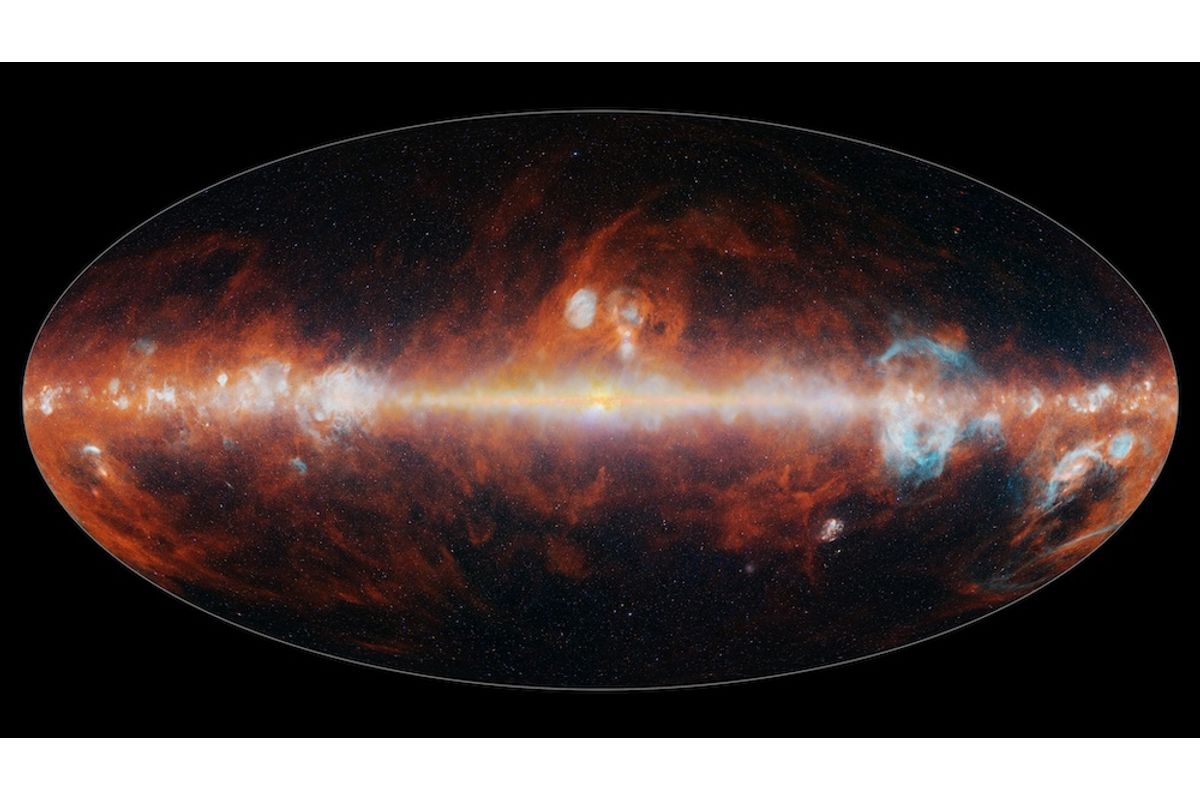
Less than a year after its launch, NASA’s SPHEREx observatory has mapped the sky, painting the entire universe in 102 colors invisible to the human eye.
The project has the potential to help astronomers solve some of the cosmos’ greatest mysteries. Crucially, NASA hopes the map will provide insight into the first fraction of a second after the big bang and a process called inflation.
“We essentially have 102 new maps of the entire sky, each one in a different wavelength and containing unique information about the objects it sees,” Shawn Domagal-Goldman, director of the Astrophysics Division at NASA Headquarters in Washington, said in a statement. “I think every astronomer is going to find something of value here, as NASA’s missions enable the world to answer fundamental questions about how the universe got its start, and how it changed to eventually create a home for us in it.”
Creating a Colorful Cosmic Map
NASA’s Spectro-Photometer for the History of the Universe, Epoch of Reionization, and Ices Explorer (SPHEREx) was launched on March 11, 2025, and began the process of mapping the cosmos in May. Six months later and it has produced its first all-sky scan.
It’s an intensive process that has seen the telescope revolve around the Earth approximately 14.5 times a day. Every 24 hours, it takes around 600 exposures, each of which are sent to six detectors paired with a filter with a gradient of 17 colors, resulting in about 3,600 images. Once an exposure is completed, the observatory moves, ready to take the next one.
Through this process, called spectroscopy, astronomers have captured the entire sky in 102 colors, each representing a wavelength on the infrared spectrum. This is not the first time a telescope has taken an image of the entire sky, but none have done so with as many wavelengths or colors, say astronomers.
“I think this makes us the mantis shrimp of telescopes, because we have an amazing multicolor visual detection system and we can also see a very wide swath of our surroundings,” Beth Fabinsky, the SPHEREx project manager at JPL, said in the statement.
Read More: New Images of Comet 3I/ATLAS Reveal “How Magical the Universe Could Be”
Solving Cosmic Mysteries
SPHEREx is mid-mission and will continue orbiting the Earth for another 18 months or so, during which time it will complete a further three all-sky scans.
By the time the mission comes to an end, the telescope will have completed over 11,000 orbits around the planet and gathered data on over 450 million galaxies. With this information, scientists will create 3D maps of galaxies, calculate the distance of faraway galaxies, and determine variations in their distribution. This, in turn, will enable researchers to trace their evolution through cosmic history and search for substances like water, which are vital for life.
It is also hoped the data collected will lead to discoveries that improve our understanding of what happened immediately after the big bang, during a process called inflation. This period of inflation lasted just a fraction of a second (10-32 seconds, to be precise). Within that time, the universe expanded dramatically, increasing by a factor of 1030, according to the European Space Agency (ESA). Events that took place in that short time – including random quantum fluctuations – have shaped the way the universe looks today.
“SPHEREx is a mid-sized astrophysics mission delivering big science,” JPL Director Dave Gallagher, said in the statement.
Read More: Newly Detected Supernova Exploded When the Universe Was Just 730 Million-Years-Old
Article Sources
Our writers at Discovermagazine.com use peer-reviewed studies and high-quality sources for our articles, and our editors review for scientific accuracy and editorial standards. Review the sources used below for this article:

