

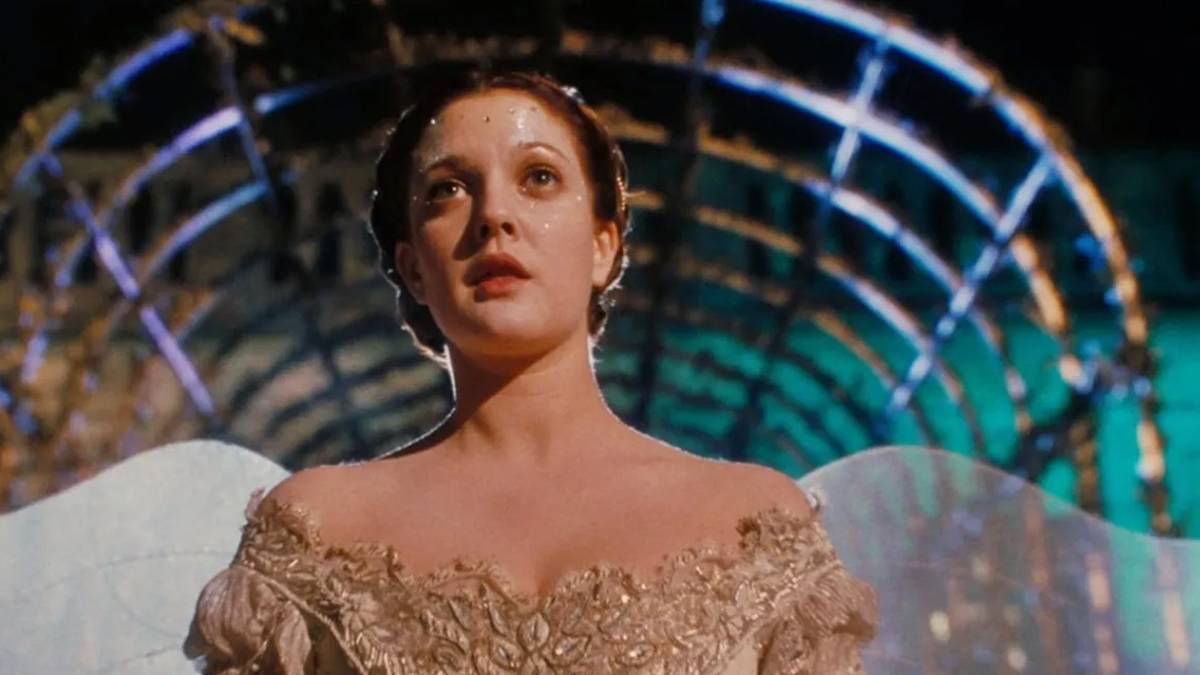
Of all the innumerable fairy tale retellings, creatives keep turning to Cinderella for inspiration. Present in some form across almost every culture, the ancient folk story has it all: a beleaguered heroine triumphing over strife, a dazzling love story, some dashes of magic, and plenty of ballgowns. And of those interpretations, few reinvent the narrative’s bones with as much wit, imaginative grandeur, sense of historical place (with artistic liberties, of course), and feminist leanings that are far more thoughtful than recycled girl power slogans, as Ever After. Released in 1998, heroine Danielle de Barbarac’s (Drew Barrymore) unrepentant passion, resilience, and self-rescuing competence endeared her to generations of women.
A specific moment — one worthy of the “iconic” designation — involves Danielle twisting a man’s words back on him and reclaiming control of a tense situation. While Danielle and her love interest, Prince Henry (Dougray Scott), are lost in the woods, a group of Romani defeat Henry in a sword fight. They have an existing grudge against the prince due to an earlier scuffle, but fairly agree to release Danielle. She demands they return her discarded dress and give her a horse for traveling. Mocking her imperious tone and assumed feminine weakness, they assure Danielle that she can safely walk away with whatever she’s capable of carrying. A woman familiar with grueling labor, Danielle proceeds to haul Henry across her shoulders, drop a mocking bow, and stride away with determined purpose. Her prince rolls with it, and their delighted adversaries call a truce. Although the scene is already a first-rate subversion played for laughs, the scene has impressive historical precedence.
A Medieval Civil War Inspired ‘Ever After’s “Carry” Scene
In 1137, the death of the Emperor Lothair III left a power vacuum across the medieval era’s Holy Roman Empire. The late ruler’s ostensible heir, Duke Henry the Proud of the House of Welf, was a natural front-runner to succeed his father-in-law. However, the region’s princes elected Conrad III of the Hohenstaufens instead, a nobleman from a different familial dynasty. Years earlier, when Conrad and his older brother were both denied access to the throne, surrounding local cities protested by crowning Conrad as their “anti-king.” Henry, incensed by his own snub, refused to pledge loyalty to Conrad, prompting the new emperor to strip Henry of his titles. His family and other supporters sparked a civil war by flocking to the defense of their former prince.
The 9 Darkest Fairy Tale Shows of All Time, Ranked (#5 Is a Cult Classic)
Some of these are pretty Grimm.
Henry passed away two years later, but the clashes continued apace. In 1140, after Conrad launched an extended siege against one of the Welfs’ last strongholds, the German town of Weinsberg, he successfully seized the city and its castle of the same name. Since Henry’s forces surrendered, Conrad allowed the castle’s women to depart with whatever they could hoist onto their backs. According to various German legends and historical documents, these women abandoned all valuable possessions and marched off carrying their husbands. That act almost undoubtedly saved the men’s lives, given how many of them Conrad would have been executed as enemy soldiers or future threats. Potentially amused and likely impressed by being outsmarted, Conrad rewarded the women’s cleverness and didn’t break his word.
Even ‘Ever After’s Comedic Scenes Underscore Danielle’s Ingenuity
The remarkable event colloquially goes by the title “the women of Weinsberg” or “the loyal wives of Weinsberg.” The castle’s remnants were renamed to Weibertreu, which loosely translates to “wifely loyalty.” Given how long ago the siege of Weinsberg occurred, the recollections about these women may be exaggerated rumors or entirely fictional. Either way, it makes for a remarkable incident that celebrates the factual cunning, courage, defiance, and strength of the countless women history has erased or forgotten. Since Ever After straddles the line between period accuracy and romantic escapism, the tale could hardly be a better (albeit less dangerous and fully fictionalized) match for Danielle’s own cunning and rebellious independence. After all, she’s a queen long before she marries into royalty.
Ever After is available to stream on Hulu in the U.S.