

Even after centuries of scientific exploration, Earth is still full of surprises. Millions of species have been described so far, but thousands more continue to emerge each year, helped along by new tools like DNA sequencing that allow researchers to spot differences that once went unnoticed.
Each find adds another piece to the puzzle of how ecosystems work and why conservation starts with understanding what’s actually there. This year’s discoveries take us across the globe, from the deep sea to cloud forests and high mountain ranges.
Here are some of the most intriguing species scientists introduced to the world in 2025.
1. Man-o-War (Physalia Mikazuki)
Ph.D. student Yoshiki Ochiai was strolling along Sendai Beach, a popular surf spot in Japan’s Tohoku region, when he spotted a creature he’d never seen in the area before. Following instinct, he packed the jellyfish-like specimen in a plastic bag and brought it back to the lab.
Man-o-war (Physalia Mikazuki)
(Image Courtesy of © Tohoku University / Cheryl Lewis Ames et al.)
“When he sent me the video taken of the live specimen inside a tank in my lab I thought — Hmmm. A ‘man-o-war’ in Sendai?” says Cheryl Lewis Ames, professor of international marine sciences at Tohoku University. “I told the students we need to get on this now. This is very likely a new species!”
Sure enough, the find turned out to be a new man-o-war species, a poisonous ocean critter that looks like a jellyfish but is actually a colony of polyps.
Named Physalia mikazuki to honor a local samurai warrior, its discovery highlights shifting marine ecosystems. As Ames explains, rapidly changing conditions are bringing new species in while resident populations decline. With stinging tentacles, monitoring this species is crucial for local beachgoers.
Read More: Giraffes Are Long-Necked and Spotted, and Apparently Four Separate Species
2. Carnivorous “Death-Ball” Sponge (Chondrocladia sp. nov.)
Sponges are usually seen as passive filter feeders, which are low on the food chain, but the newly discovered carnivorous “death-ball” sponge flips the script. Straight out of a sci-fi comic, this invertebrate skips boring plankton for small animals, trapping them with tiny hooks on its body.

Carnivorous “death-ball” sponge, Chondrocladia sp. nov., found by the ROV SuBastian.
(Image Courtesy of The Nippon Foundation-Nekton Ocean Census/Schmidt Ocean Institute © 2025)
Discovered earlier this year by the Schmidt Ocean Institute’s R/V Falkor (Too), the deadly sponge was among 30 deep-sea species uncovered after a massive iceberg calved from a floating Antarctic glacier.
While the rapid changes in our natural environments are concerning, they also give scientists a chance to discover unknown life and remind us why protecting our planet matters.
3. Venomous Deep-Sea Snail (Turridrupa magnifica)
Don’t be fooled by this snail’s unassuming appearance. Found at depths of 650 to 1,600 feet in the South Pacific near New Caledonia and Vanuatu, this deep-sea hunter packs a punch, says a news release. Using harpoon-like teeth loaded with venom, its prey doesn’t stand a chance.

A newly identified predatory gastropod, Turridrupa magnifica is a new deep-sea snail that harpoons its prey with venomous teeth.
(Image Courtesy of The Nippon Foundation-Nekton Ocean Census / Peter Stahlschmidt © 2025)
The twist? Venom from its relatives has already shown surprising medical potential, by helping with pain management and even targeting cancer cells, according to a study published in J Proteomics.
Discovering new species like this snail isn’t just exciting but could have real-world benefits for human health. Each find is a reminder that exploring and protecting Earth’s hidden corners might hold the key not only to biodiversity conservation but also to our own survival.
4. Guitar Shark (Rhinobatos sp.)
Guitar sharks blur the line between sharks and rays, with angel-like wings and a robust shark tail that together resemble a musical instrument.

Newly identified guitar shark, Rhinobatos sp., found off Tanzania.
(Image Courtesy of The Nippon Foundation-Nekton Ocean Census / Sergey Bogorodsky © 2025)
A new member of this critically endangered family was recently discovered in the Indian Ocean at around 650 feet near Mozambique and Tanzania, according to a news release.
Predators like guitar sharks play a vital role in keeping marine ecosystems balanced. While this new specimen is still awaiting an official description and name, its discovery highlights the importance of continued exploration.
5. West Australian Lanternshark (Etmopterus westraliensis)
In the gloomy twilight zone off Western Australia, producing your own light can be a major survival advantage.

West Australian Lanternshark, Etmopterus westraliensis
(Image Courtesy of CSIRO-Cindy Bessey)
Found at depths around 2,000 feet, this new lanternshark is just 16 inches long, but sports large eyes perfectly suited for the dim conditions of its deep-sea home, according to a news release.
Even more spectacular is its bioluminescent underside. This glowing ability helps with communication, luring prey, and even camouflage, allowing the shark to blend with the faint sunlight filtering from above.
6. Porcelain Crab (Porcellanella brevidentata)
Along Western Australia’s Ningaloo Coast, a tiny new ocean dweller has captured scientists’ attention with its delicate beauty.

Porcelain crab, Porcellanella brevidentata
(Image Courtesy of CSIRO Australian National Fish Collection)
The porcelain crab, measuring just 15 millimeters across, looks like an intricate piece of marine jewelry, but it’s perfectly adapted to its home among the white leaves of a sea pen, a type of soft coral, according to a news release.
Found at around 400 feet deep, these crabs feed on plankton, filtering their tiny meals from the water. This particular species has especially short teeth, which inspired its name, brevidentata.
7. Bumpy Snailfish (Careproctus colliculi)
While exploring the seafloor around California’s outer Monterey Canyon, researchers discovered one of three new snailfish species at a staggering depth of 10,722 feet.
Using the remotely operated vehicle Doc Ricketts, they spotted an unfamiliar pink fish hovering just above the ocean floor. The adult female, measuring about 3.6 inches, was collected and brought back to the lab for closer study.
Part of the Liparidae family, snailfish typically have jelly-like bodies, narrow tails, and large heads — and they hold the record for the deepest-dwelling fish known. This new species, nicknamed the “bumpy fish,” stands out with its large eyes, pronounced head, and textured skin, giving it a unique appearance among its deep-sea relatives.
Read More: This Species of Ancient Scottish Reptile Is Part Snake and Part Lizard
8. Bent-Toed Geckos (Cyrtodactylus himachalensis and Cyrtodactylus shivalikensis)
During a recent survey of the western Himalayas, researchers stumbled upon two new species of bent-toed geckos in Jammu and Kashmir and Himachal Pradesh.

Bent-toed geckos, Cyrtodactylus himachalensis and Cyrtodactylus shivalikensis
(Image Courtesy of Bhardwaj, Purkayastha, Lalremsanga, and Mirza, 2025)
“The Himalayas are a known biodiversity hotspot and are also known for the high number of endemic species. While the eastern Himalayas are more diverse, the western part hosts distinct evolutionary lineages. We were confident we’d find interesting species — and we did!” says Zeeshan A. Mirza, Ph.D. student at the Max-Planck-Gesellschaft, Tübingen, Germany, and co-author of the study describing the find, published in Zootaxa.
The geckos’ names celebrate their homes. Cyrtodactylus himachalensis honors Himachal Pradesh, while Cyrtodactylus shivalikensis nods to the Shivalik Hills, where it was collected. Beyond their novelty, these geckos are important players in the ecosystem.
“They act as biological pest controllers, preying on insects while also serving as food for snakes, larger lizards, and birds,” explains Mirza.
Even in the less-visited western Himalayas, these tiny hunters play a big role in maintaining balance.
9. Pumpkin Toad (Brachycephalus lulai)
Tiny enough to perch on the tip of a pencil, the pumpkin toad is an adorable splash of color hidden in the cloud forests of southern Brazil.

Tiny pumpkin toadlet, Brachycephalus lulai, measuring less than 14 mm in length.
(Image Credit: Luiz Fernando Ribeiro, CC-BY 4.0)
Discovered in the misty, high-altitude rainforests of the Serra do Quiriri mountain range, this carrot-hued amphibian reaches just half an inch in length. Its bright orange skin, dotted with brown and green patches, looks more like a high-visibility jacket than camouflage, yet the toadlet is surprisingly hard to spot.
Instead, researchers found it by sound. Male pumpkin toads produce distinctive advertising calls to attract mates, and it was this vocal performance, not their looks, that revealed their presence.
10. Giant Stick Insect (Acrophylla alta)
Australia, already famous for its deadly critters, has a new record-holder: the heaviest insect ever recorded in the country.

Giant stick insect, Acrophylla alta
(Image Courtesy of Ross M. Coupland)
The giant stick insect, Acrophylla alta, calls the Atherton Tablelands in North Queensland home, where it thrives by blending into the cooler, remote tropical canopies, according to a news release.
Measuring nearly 16 inches and weighing around 1.5 ounces, this massive insect likely owes its size to adaptations for the region’s cooler temperatures. Its remote habitat, rarely visited by people, allowed it to go undetected — until now.
11. Gynandromorph Spider (Damarchus Inazuma)
In the forests of western Thailand, researchers uncovered a striking new tropical spider that seems to have stepped out of a horror movie.
Among the specimens, some displayed a rare natural trait called gynandromorphism, where half the body shows female characteristics, while the other half is distinctly male. In some individuals, the female side is larger and orange, while the male side is smaller and grayish, creating an eerie, almost Frankenstein-like appearance.
Part of the mygalomorph infraorder, which includes tarantulas, these spiders have differently shaped fangs and prefer burrows to complex webs. The new species was named Damarchus inazuma after a character from the popular manga One Piece, known for the ability to change sex between male and female, a fitting homage to this spider’s rare sexual mosaic.
Read More: Over 100,000 Unlikely Spider Species in a Cave Built the Largest Web in the World
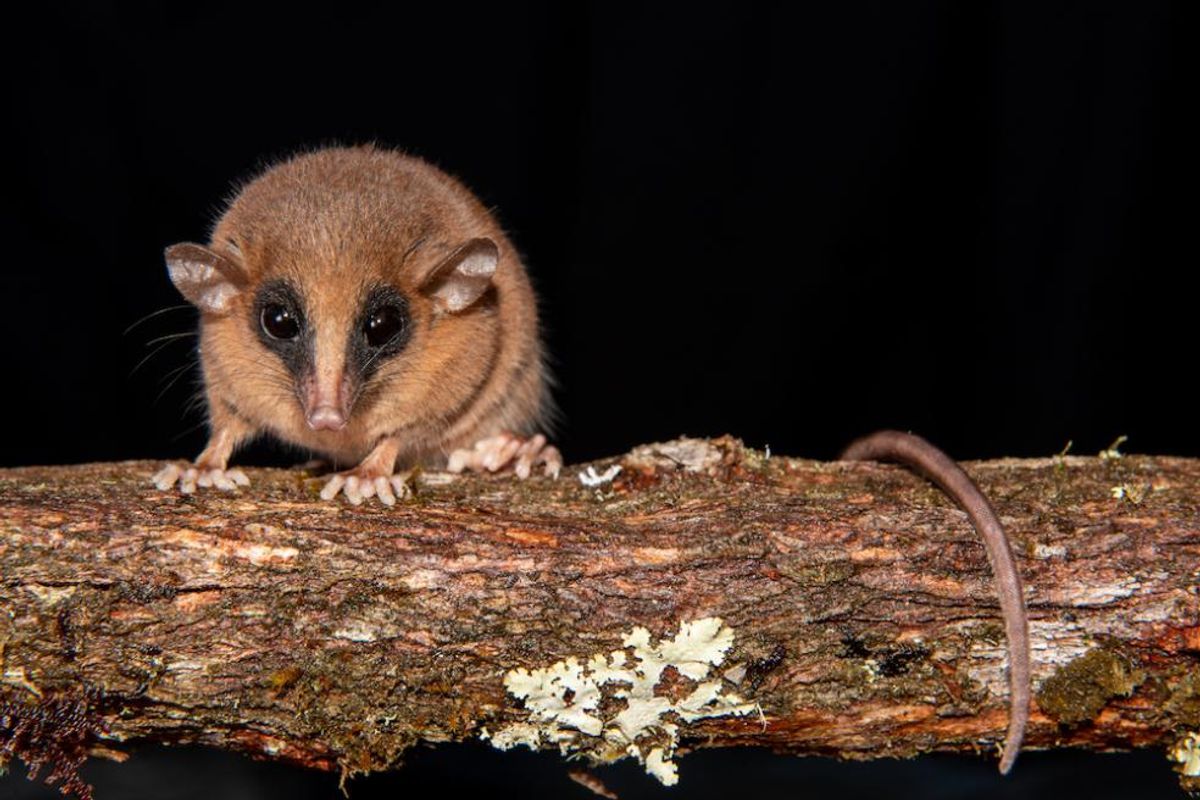
12. Mouse Opossum (Marmosa Chachapoya)
While searching for a mysterious squirrel in Peru’s eastern Andes, researchers stumbled upon a surprising find: a previously undocumented mouse opossum at almost 9,000 feet, according to a news release.

Mouse opossum, Marmosa chachapoya
(Image Courtesy of Pedro Peloso)
“The animal was found at a much higher altitude than most other species of mouse opossums. It also looked unique with its slender and long snout,” says lead researcher Silvia Pavan, assistant professor at Cal Poly Humboldt.
With reddish-brown fur, mask-like facial markings, and a body just 4 inches long, this tiny marsupial was named Marmosa chachapoya to honor the region’s pre-Inca culture.
“This discovery underscores the need for continued exploration in the Andes,” she adds.
13. 1,500th Bat (Pipistrellus etula)
On Bioko Island in Equatorial Guinea, a team of researchers uncovered a tiny new bat species, marking the 1,500th bat known to science during a 2024 biodiversity survey of the island’s highlands, according to a news release.

1500th bat species, Pipistrellus etula
(Image Courtesy of Laura Torrent)
“One of our goals during the surveys was to explore the highlands, like Basilé Peak, which are hard to reach and scarcely studied. When we captured several small bats that didn’t match any guides, we knew we were onto something special,” says Laura Torrent, Ph.D. student at the BiBio Research Group and former Bat Conservation International Student Scholar.
Comparisons with museum specimens from 1989 and modern genetic analysis confirmed the bats were indeed a new species.
Named Pipistrellus etula after the Bubi word for “island” to honor Bioko’s Indigenous people, these bats live in cool, high-altitude forests above 2,000 metres — a habitat no other similar bats occupy.
“It was an incredibly exciting moment, reminding us that even in 2024, nature still holds surprises,” adds Torrent.
14. Ethiopian Shrew (Crocidura stanleyi)
In the mountains of northern Ethiopia, mammologist William T. Stanley made a surprising discovery during his final fieldwork: a tiny shrew that turned out to be a species new to science. Named Crocidura stanleyi in his honor, the diminutive mammal weighs just 3 grams (about the same as a penny).

Ethiopian shrew, Crocidura stanleyi
(Image Courtesy of Craig et al (2025))
This bicolored shrew has dark, brownish-gray fur on its back and lighter gray underneath, with a head and body measuring roughly 2 inches and a tail adding another 1.2 inches, according to a study published in the Journal of Vertebrate Biology.
Endemic to this part of Ethiopia, the species highlights the region’s wealth of mammals found nowhere else in the world.
Read More: The Moss in Your Christmas Decorations Could Be Storing DNA From Rare Species
Article Sources
Our writers at Discovermagazine.com use peer-reviewed studies and high-quality sources for our articles, and our editors review for scientific accuracy and editorial standards. Review the sources used below for this article:

