

Many of us think of our own species as a monogamous one. We select a mate, and we stick with them, or so we tend to believe. But are modern humans really as monogamous as we assume, and are we any more monogamous than, say, a deer mouse or a wild dog?
A new paper published in the Proceedings of the Royal Society B: Biological Sciences attempts to answer these questions. Presenting a clear method for calculating the reproductive monogamy rates of mammals through their proportions of full and half siblings and applying that method to over 30 mammal species, the study suggests that modern humans (Homo sapiens) are actually relatively monogamous, though we certainly aren’t the most monogamous mammals out there.
“There is a premier league of monogamy, in which humans sit comfortably, while the vast majority of other mammals take a far more promiscuous approach to mating,” said Mark Dyble, a study author and an anthropologist at the University of Cambridge, according to a press release. “The finding that human rates of full siblings overlap with the range seen in socially monogamous mammals lends further weight to the view that monogamy is the dominant mating pattern for our species.”
Read More: 5 Animals That Mate for Life
Are Humans Monogamous?
Human monogamy is a contentious topic among anthropologists, having caused controversy for centuries. While some anthropologists classify H. sapiens as monogamous, arguing that monogamy has helped our species stick together in tough times, others stress that many mating systems (monogamous and polygamous) are observed across human cultures, past and present, leaving the nature of human mating a subject of continuing mystery.
Of course, some scientists have turned to fossils and anthropological records to solve this mystery, though their results have remained relatively limited. Meanwhile, field observations and paternity tests have helped researchers piece together a picture of the mating patterns in other species, though their ability to compare these mammals’ mating practices to our own is also relatively restricted.
Setting out to address these issues, Dyble created a computational model that can assess the relative rates of full and half siblings in H. sapiens and other mammals, resulting in a more consistent and more concrete measure of reproductive (rather than sexual) monogamy throughout the mammalian family tree.
Combining genetic and ethnographic data from ancient and contemporary H. sapiens (including data from human archaeological sites and an assortment of human cultures, from the Hadza in Tanzania to the Toraja in Indonesia) and comparing them to data from other mammals, the method ranks the rates of mammalian monogamy, with higher rates of full siblings corresponding to higher rates of reproductive monogamy.
Read More: Mates for Life? The More We Learn About Animal Sex, the Rarer True Monogamy Becomes
Mammal Monogamists, Ranked
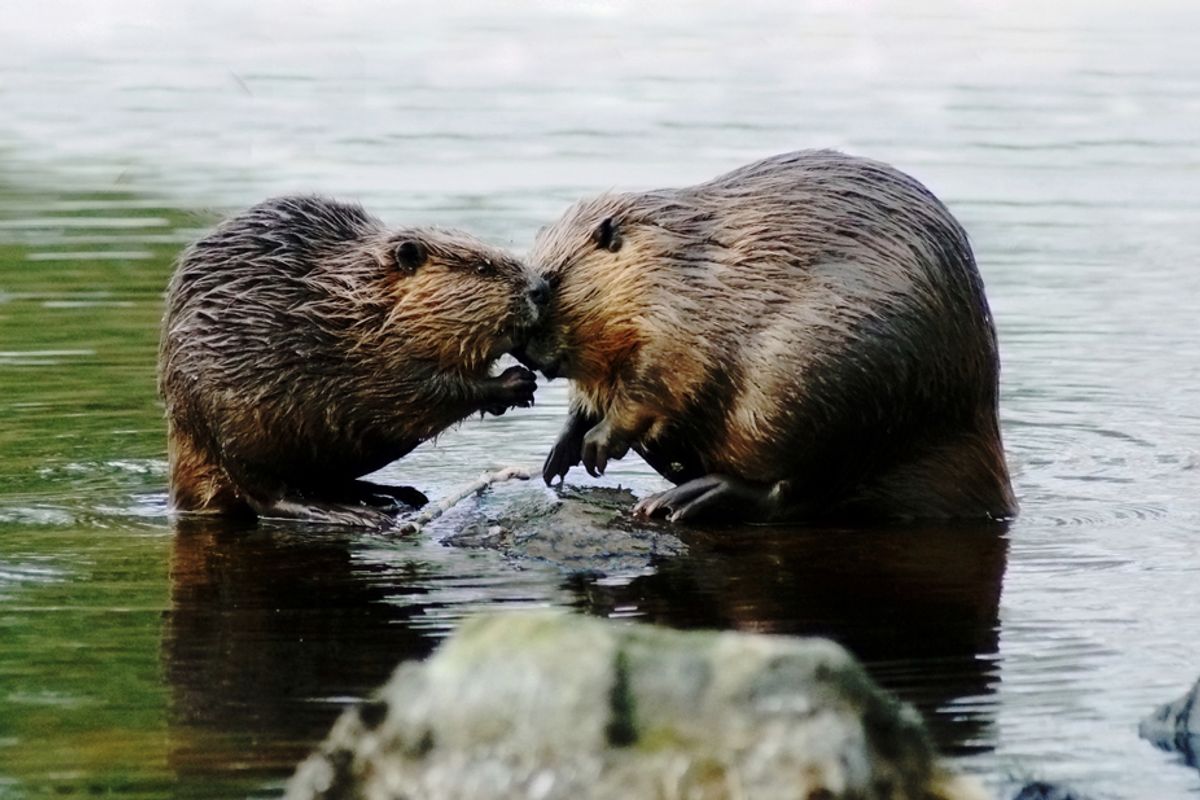
Running the model, Dyble calculated that around 66 percent of H. sapiens siblings are full siblings, putting modern humans between beavers (at 73 percent) and meerkats (at 60 percent) as the seventh most monogamous of 11 “socially monogamous” species and 35 species in total.
That ranking means that humans are less monogamous than the most monogamous mammals, and much more monogamous than the most polygamous ones. In fact, while 100 percent of California deer mouse siblings and 85 percent of African wild dog siblings are full siblings, making them the most monogamous species studied, only around 1 percent of Soay sheep siblings are full siblings, making them the most polygamous.
According to Dyble, the only mammals more similar to modern humans than beavers and meerkats were white-handed gibbons, whose percentage of full siblings was approximately 64 percent.
Meanwhile, the moustached tamarin was the third and final “socially monogamous” primate, with a full sibling proportion of 78 percent, while the other primates studied were strongly polygamist, with mountain gorillas, chimpanzees, and several species of macaques having full sibling rates of 6 percent, 4 percent, and around 1 to 2 percent, respectively.
Although the results reveal that modern humans are more reproductively monogamous than not, Dyble still emphasizes the wide range of mating strategies observed among H. sapiens.
“There is a huge amount of cross-cultural diversity in human mating and marriage practices, but even the extremes of the spectrum still sit above what we see in most non-monogamous species,” Dyble concluded in the release. “Based on the mating patterns of our closest living relatives, such as chimpanzees and gorillas, human monogamy probably evolved from non-monogamous group living, a transition that is highly unusual among mammals.”
Read More: From Komodo Dragons to California Condors, These Animals May Reproduce On Their Own
Article Sources
Our writers at Discovermagazine.com use peer-reviewed studies and high-quality sources for our articles, and our editors review for scientific accuracy and editorial standards. Review the sources used below for this article:

