

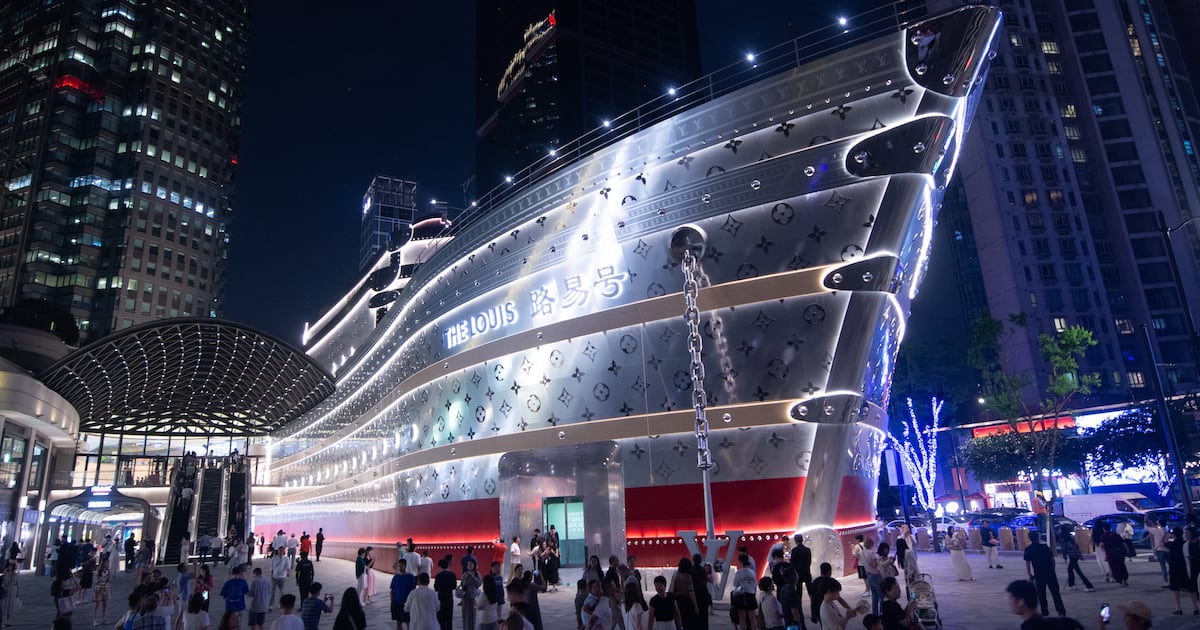
At any given moment, the ship-shaped Louis Vuitton flagship on Shanghaiâs Huaihai Road is surrounded by people of all ages taking selfies.
The scene would suggest Chinaâs shoppers are clamoring for luxury once again. Cecile Cabanis, LVMHâs chief financial officer, noted on the companyâs October earnings call that even neighbours of Louis Vuittonâs Shanghai ship were happy because the store was âdriving so much traffic.â
But beneath the camera flashes lies a subtler reality: Chinaâs luxury market, which accounts for roughly a third of the sectorâs worldwide sales, may have finally stabilised after two challenging years, but itâs still on shaky ground.
The country is a vital source of luxury sales. In 2019, Chinese consumers accounted for 90 percent of the sectorâs constant growth, according to Bain & Company. Sales continued to surge through the countryâs Covid lockdowns, as consumers who once spent abroad were forced to splurge at home. But economic factors such as a real-estate crisis and high youth unemployment have hammered the market in recent years. Bain estimates it contracted as much as 20 percent in 2024, with growth this year projected to be flat.
Finally, however, luxury brands are signalling cautious optimism: LVMHâs fashion and leather goods division reported a return to growth in Mainland China in the third quarter. Hermès cited a very slight improvement. Kering and Prada flagged better trends in the region.
The results come with a caveat. âWhatâs interesting is most companies are cautioning this seems to be driven by the easy comparative quarter last year,â said Chiara Battistini, luxury analyst at J.P. Morgan. âWe are still dealing with volatile consumers that can show up during events like Golden Week and then fade.â
Even so, it looks like the end of the downturn. Bernstein analyst Luca Solca forecasts a slight rebound for Chinaâs luxury market in 2026. HSBCâs Erwan Rambourg â who recently upgraded LVMH to âbuyâ â said in a recent research note that luxury growth in 2026 may be modest but sustainable.
Luxury players shouldnât view this as a prelude to the growth rates of old returning, however.
âI think that the worst is over, but I donât think that we will ever see again in the near future what we have seen in the last decade,â Prada chief executive Andrea Guerra said on the companyâs earnings call last month.
Whatâs emerging in China is a more discerning and competitive market, in which brands will need to focus on high-quality, culturally resonant offerings rather than sheer volume, according to Ramourg.
âThis is what a mature market looks like,â said Jacques Roizen, managing director of China consulting for Digital Luxury Group, a digital agency for luxury brands. âGrowth is earned, not given.â
A More Discerning Market
âAreas around stores like the Louis Vuitton flagship are very full now,â said Shanghai-based luxury influencer Crystal Yoo. âBut top luxury malls have never been too full â in 2023 there was revenge shopping, but people are more rational now.â
Roizen echoed the sentiment. âToday, consumers are more cautious, more strategic, but people are spending more than a year ago.â
In Roizenâs view, the pandemic surge was an unsustainable anomaly. Once travel resumed in 2024, so did outbound spending. Today, more than half of Chinese luxury purchases are once again made outside China, he said.
Combined with the ongoing macroeconomic challenges â like the property crisis, unemployment, trade tensions with the US and an aging population â it has left a more competitive domestic environment where only true overperformers will gain market share.
âBrands with timeless codes and consistent execution, like Hermès, Moncler and Brunello Cucinelli, are outperforming,â said Battistini.
Hermès, shielded from macro-woes with its ultra high-net-worth clientele, continues to expand quietly in secondary Chinese cities while maintaining its perception of exclusivity. At Moncler, collaborations with local talent, shops in premium locations and events like last yearâs âCity of Geniusâ have allowed the outerwear brand to expand its cultural relevance. Bottega Venetaâs 2025 âA Poetic Conversationâ poetry installation at the Shanghai Rowing Club, featuring anthologies by Chinese poet Yu Xiuhua, arranged in a three-dimensional Bottega brandmark, garnered widespread positive feedback.
To stand out in the marketplace, products need to provide deeper value. âConsumers want meaning,â said Battistini. âThey want to see themselves reflected in a brand.â
In China, that evolution carries particular weight. The affluent middle class is no longer overbuying luxury with big logos to prove success. Purchases are shifting towards nuanced expressions of identity, demanding that brands translate emotion and values â not just language â to resonate with target customers.
From Status Symbols to Cultural Relevance
If the 2010s were about China catching up to Paris and Milan, the 2020s are about cultural self-confidence.
âBeing Chinese is cool again,â said Bohan Qiu, founder of Shanghai-based creative agency Bo Project. âYounger consumers donât see much difference between Western and Chinese brands. They just want what feels real.â
Homegrown labels like Ruohan â an influential voice in Chinaâs âquiet luxuryâ movement â and Laopu Gold, which fuses traditional goldsmithing with minimalist design, are cultivating loyal followings among young professionals who value craftsmanship with a cultural heartbeat.
European maisons are still coveted, but the terms of engagement have changed. Todayâs consumers expect sensitivity, creativity and respect. Qiu said itâs not enough for campaigns to just use Chinese models, though key celebrity ambassadors and campaign faces are still crucial to most brandsâ marketing strategy.
âHigh-net-worth individuals place greater emphasis on experience,â said Janice Lam Na Cheung, director of mainland business operations for Hang Lung Group, which manages Shanghai luxury mall Plaza 66. âThey hope to personally participate in brand stories and create shared memories.â
Surface-level appeals can ring hollow. Yoo said many brands want easy sales during the Chinese New Year, so they launch zodiac-related designs.
âSometimes theyâre really ugly,â she said. She hopes to see better in 2026, the year of the horse.
Brands that have sought out highly localised marketing â from platforms to content and endorsements â are starting to see long-term dividends. Loeweâs 2022 collection, inspired by Chinese monochrome ceramics, included sponsorship of an educational program at Jingdezhen Ceramic University and received positive feedback on Chinese social media. The brandâs most recent âLoewe Crafted Worldâ exhibition in Shanghai was hugely popular.
Lemaire has taken to launching exclusive capsule collections in honour of Chinese festivities: Lunar New Year, Qixi Day (Chinese Valentineâs Day) and the Mid-Autumn festival, with new sizes and colours of brand icons like the croissant bag sold through their Chengdu flagship or through Chinese retailer Tmall. It engages local photographers and talent to create storytelling with deep emotional resonance, like the âcoming homeâ journey for New Years, when families reunite. The engagement with special occasions locally has created a cult following that transcends borders.The brandâs corner in Parisâ Galeries Lafayettes is a magnet for Chinese tourists, with sales staff fluent in Mandarin to cater to the demand.
âThereâs humility in the best examples,â said Qiu. âTheyâre not pretending to be Chinese â theyâre showing respect.â
E-commerce remains a key channel in China, with Alibabaâs Global Shopping Festival on 11.11 âSingleâs Dayâ reaching a historic high in 2024 and the upcoming edition including new AI-elements to up efficiency.
Brands can also grab attention with flashy stores and on-the-ground activations, such as Pradaâs âPradasphereâ pop-ups or Cartierâs heritage exhibitions. At their best, they encourage shoppers to snap selfies that they post online â what Roizen called âthe new billboard.â
But visibility is only half the battle. The bigger challenge is turning attention into loyalty.
âLuxury needs to speak the language of endurance,â Qiu said. âIf a brand feels too desperate to be trendy, people sense it.â
Brands that want to succeed in China now must be in it for the long haul. The days of easy wins are over.
âThe ones growing now are those who innovate, optimize and localise,â Roizen said. âEveryone else is waiting for the old China to come back.â

