

/https://tf-cmsv2-smithsonianmag-media.s3.amazonaws.com/filer_public/57/26/57269a83-67e1-4a00-8595-c33af535deaa/106271_web_web.jpg "From Dinosaur Scratches to Insects in Amber, How Paleontologists Uncover Prehistoric Courtship")
Researchers have found fossil evidence of varied creatures wooing and mating, as they continue to search for the telltale signs of dinosaurs copulating
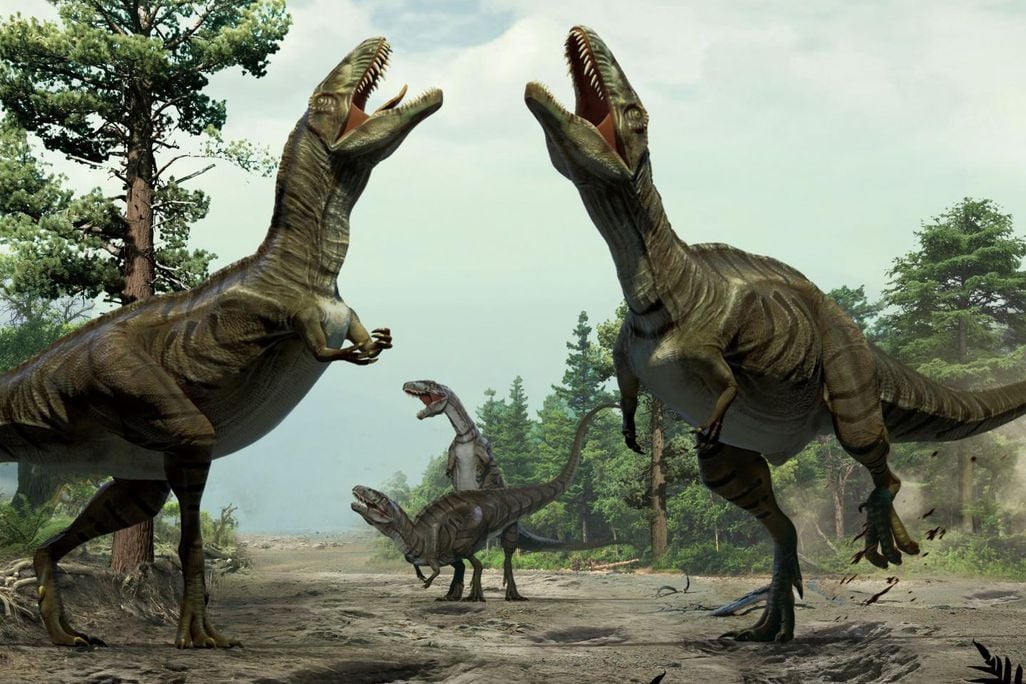
Predatory dinosaurs like Acrocanthosaurus perform a mating dance. Fossils indicating such a dance took place, possibly by this species, were described in 2016.
Artwork by Lida Xing and Yujiang Han / University of Colorado Denver
Key takeaways: Evidence of dinosaur courtship
- Earlier this summer, researchers announced they found fossils that likely come from courting dinosaurs.
- To find more fossil evidence of prehistoric animals wooing and mating, scientists will have to keep their minds open.
At a glance, the prehistoric potholes dotting the 100-million-year-old rock of Colorado’s Dinosaur Ridge might not look like much. The divots in the orange rock are rough and uneven, as if they were parts of the surface that had eroded away. Upon closer investigation, however, paleontologists found that these notches in the rock are a testament to the tender side of dinosaurs. The holes were made by courting dinosaurs as they tried to impress each other with how well they could scratch out a nest.
The behavior of the dinosaurs was similar to that of some birds alive today. Old Dominion University paleontologist Caldwell Buntin, who studied the site, notes that dinosaurs related to carnivores like Allosaurus gathered at the spot to show off their nest-making skills. “During nest displays of piping plovers, a display nest is built by a male and when visited by a female will perform additional scrape displays that kick sediment around the nest,” Buntin says. Whether the scraped spots were actually used as nests or not is unclear, but they appear to have at least been an amorous demonstration.
The dinosaur display arena was announced by experts earlier this summer, the latest and largest such site uncovered since paleontologists first recognized traces created by courting dinosaurs in 2016. The dinosaur scrapes are far from the only signs of fossil courtship and mating paleontologists have uncovered. Even as the sex lives of some of our favorite fossil creatures remain mysterious, rare discoveries of prehistoric turtles that perished while mating, swarming insects preserved in amber and dancing footprints of ancient birds demonstrate how some of the most intimate and fleeting moments in prehistoric life can be preserved in the fossil record.
These marks suggest dinosaurs performed mating rituals in what is now Colorado. Caldwell Buntin/https://tf-cmsv2-smithsonianmag-media.s3.amazonaws.com/filer_public/be/54/be54a4c9-ea32-42f1-a574-d1839275f2a8/tracks.jpg)
From the perspective of geologic time, all mating behaviors are brief affairs. Whether courtship and mating occur in a matter of seconds or days, the specific and endlessly varied mating behaviors of animals are a short part of their lives. The chances of two or more organisms perishing at the same moment, in a way that would be decipherable as mating behavior, and becoming preserved in the fossil record in a place they could be discovered by experts is incredibly small.
Despite the odds, however, unusual and often catastrophic circumstances have delicately preserved animals in the act. More than 47 million years ago in what’s now Germany, pairs of the prehistoric turtle Allaeochelys were in the middle of mating when they unknowingly sank into toxic waters near the bottom of an ancient lake. The mating pairs died and were covered up by fine-grained sediment on a lake bottom so devoid of scavengers that the deceased turtles were undisturbed. A similar fate met at least one courting pair of 325-million-year-old sharks called Falcatus when they were suddenly killed, perhaps when runoff from a nearby landmass caused oxygen levels to suddenly drop. Coupling in watery habitats came with unusual risks that sometimes preserved these ephemeral moments for millions upon millions of years.
Some of the most extensive evidence of prehistoric courtship, however, is found among invertebrates. Accumulations of sea scorpions, known as eurypterids by paleontologists, suggest that the water-dwelling invertebrates gathered together on tidal flats to molt, mate and lay their eggs in the shallows. Away from the water, by contrast, sticky tree resin often covered up insects that were mating or gathering to do so, creating fossils of organisms that were otherwise too small to be preserved in layers of stone.
Just last year, paleontologist Constanza Peña-Kairath and colleagues described a swarm of 99-million-year-old thrips in amber. Thrips are small insects related to lice and cicadas that gather together in mixed-sex swarms, often around important sources of food. The thrips preserved in the Cretaceous amber are a mixed-sex group that have pollen grains attached to their bodies. When the insects gathered to feed on pollen on a tree, it was also a mating opportunity that, unfortunately for them, ended when thick resin gobbed onto them. Similar finds have been made of mating mites, springtails, dance flies and more, demonstrating how familiar courtship rituals among invertebrate groups still alive today go back tens of millions of years.
Body fossils, however, are just one small part of the story. Fossil traces made by living things, like a trackway left by a walking dinosaur, record prehistoric behavior. Marks in prehistoric sediment, like the dinosaur scratches found in Colorado, often provide glimpses of how courting animals were moving and interacting even when no bones or body fossils remain.
Around 243 million years ago in what’s now Germany, prehistoric horseshoe crabs crawled along a mud flat in search of mates. The tracks and trails they left behind resemble the traces created by modern horseshoe crabs as males follow females, hoping to hang on, to mate. It was such a gathering that tracks have been found of land-dwelling crocodiles that may have been attracted to the crowd—to pick off a few for meals or scavenge among those that may have perished. The body fossils of the crabs were not preserved here, but their behavior was.
Paleontologists often rely on modern animals to interpret prehistoric trace fossils, such as watching the divots spiders and scorpions make in sand to identify fossils their prehistoric counterparts have left in Permian rock. Relying on modern animals as guides does carry risks, however. The biggest weakness of using modern animals to understand fossil ones, Emory University paleontologist Anthony Martin says, is that some fossil organisms behaved in ways that don’t have a modern equivalent. Many dinosaurs were far larger than most land animals alive today and were quite anatomically different from the crocodiles and birds around us. So especially when it comes to dinosaurs, detecting courtship and mating behavior requires an open mind.
Tracks and other trace fossils may hold the greatest potential to uncover mating behavior, especially for animals too big to be covered in amber or buried in a single storm event. While it’s highly unlikely paleontologists will ever find Triceratops that were copulating when they died and were instantaneously buried, for example, it’s much more likely that the footsteps and other traces of courting dinosaurs might be found among the various other kinds of walking, running, digging and resting behavior paleontologists have uncovered.
In fact, Martin notes, evidence of courtship in the fossil record could appear much more frequently than direct evidence of mating. “Considering that not all courtships successfully result in mating, and the potentially large number of moves a suitor might perform, courtship traces should be far more common than remains of the suitor,” he says.
Looking for such traces will require that paleontologists keep their eyes open for the unusual. No one really knows how non-avian dinosaurs mated, for example, but some remnant could persist of a mud flat or sandy shore from the edge of a stream or lake where two sets of dinosaur tracks seem to merge. “They would probably involve both dinosaurs stopping, getting close to one another, and then staying together, but also moving in more or less the same place,” Martin says, likely appearing to be messy as the dinosaurs stepped over the tracks they already made. So far, no one has found such a fossil, but Martin is keeping his eyes open. “Hopefully what will happen is the paleontological equivalent of that famous quote from Supreme Court Justice Potter Stewart, who in 1964, when trying to define obscenity, said, ‘I know it when I see it.’”

/https://tf-cmsv2-smithsonianmag-media.s3.amazonaws.com/filer_public/57/26/57269a83-67e1-4a00-8595-c33af535deaa/106271_web_web.jpg&description=From+Dinosaur+Scratches+to+Insects+in+Amber%2C+How+Paleontologists+Uncover+Prehistoric+Courtship)