

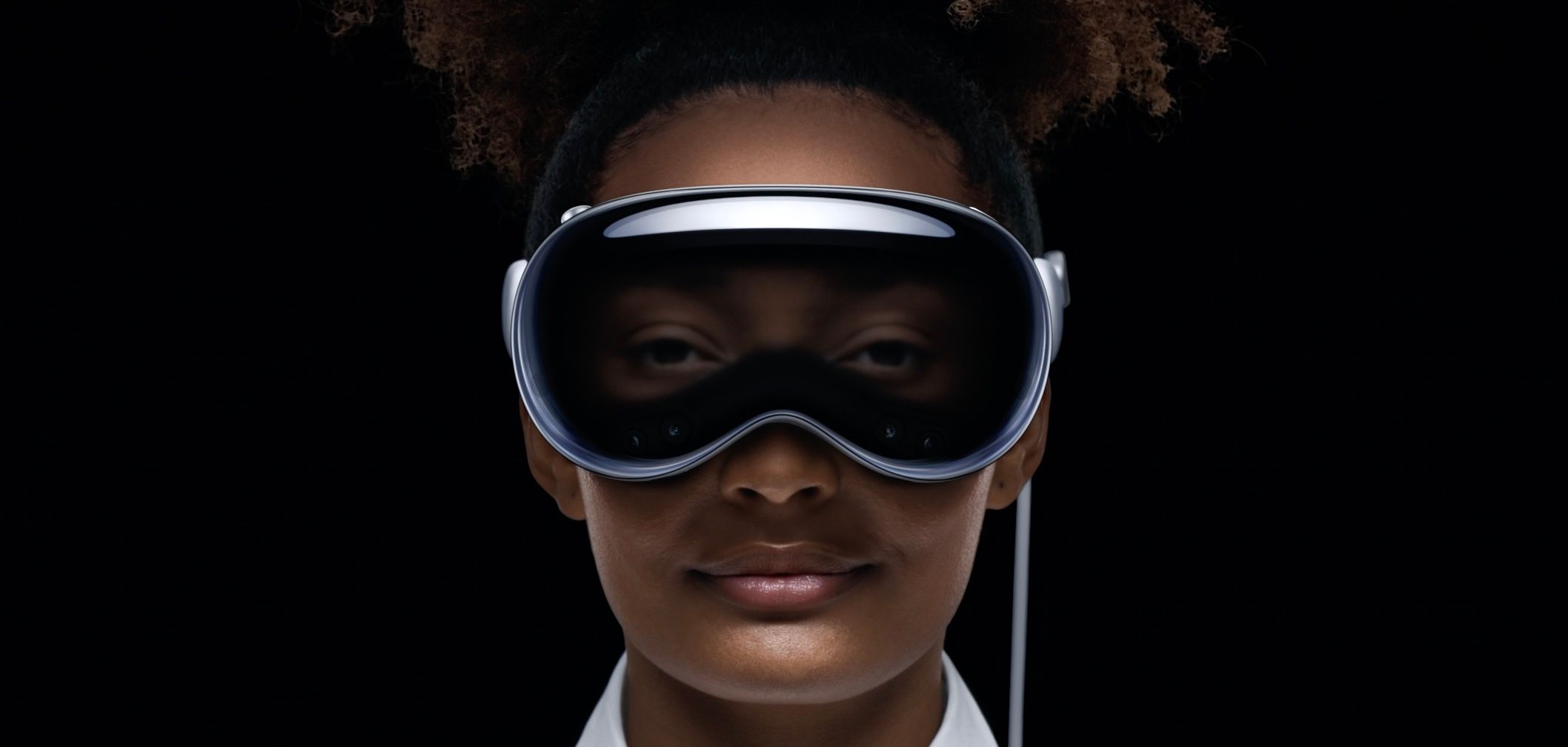
Apple has finally taken the wraps off its much-anticipated AR/VR headset, Apple Vision Pro. It comes after years of rumors and speculation about the company’s planned entry into the mixed reality space. The announcement is one of many from the start of Apple’s week-long WWDC 2023 event, where it also revealed the 15-inch Macbook Air with Apple’s M2 chip, its new M2 Ultra, and a host of upgrades for iOS, iPadOS, watchOS, AirPods, and more.
Apple’s headset, which it’s calling a “revolutionary spatial computer,” will allow wearers to control just how immersed they are in the virtual space. Users can choose to project apps and digital objects right into their living room, for example, or they can transform their home to an entirely different setting that can “grow beyond the dimensions of a physical room,” all by adjusting the Digital Crown on the headset’s upper rim. It has no controllers, relying instead on eye and hand tracking, and voice commands to “seamlessly blend the digital and physical worlds.” Unsurprisingly, that all comes at a premium; Apple Vision Pro will start at $3,499 when it launches in early 2024.
A Closer Look At Apple Vision Pro
The headset features an aluminum alloy frame with a soft Light Seal layer where it meets with the face, flexible ear straps, and a 3D knitted headband that will come in three sizes. Apple wants to make augmented reality feel natural with Vision Pro, and the device will have its own new App Store and run visionOS to inject life into apps. Apps will respond with visual feedback when looked at, and even cast shadows in response to natural light.
Users will be able to see their surroundings normally while wearing the device if they so choose, or scale apps and move items around to whatever degree they want. For controls, Apple says, “Users can browse through apps by simply looking at them, tapping their fingers to select, flicking their wrist to scroll, or using voice to dictate.” Powering the headset is a small, tethered external battery pack that can be slipped into a pocket for two hours of battery life, so the wearer is free to move around. It can also be plugged in for all day use.
What’s Inside The Headset

Vision Pro uses Apple’s M2 chip in combination with its new R1 chip, and packs an array of 12 cameras, five sensors, and six microphones, making for what Apple says is its first 3D camera. It’ll have personalized Spatial Audio and two 4K, micro-OLED displays that will let users watch movies or play games on “a screen that feels 100 feet wide.” Apple and Disney are already teasing exclusive AR content, and have said Disney+ will be available on the headset at launch. It will also be compatible with about 100 Apple Arcade games.
With a feature called EyeSight, the device will display the wearer’s eyes if approached by another person, as if it were a transparent set of goggles. For those who wear glasses, users can get ZEISS Optical Inserts (sold separately) so the headset will provide vision correction. Users will be able to use the device not just for entertainment, but for collaborative working and socializing.

It supports FaceTime with Spatial Audio, and will display participants in tiles that can be placed all around the room. The headset wearer will be shown as a digital avatar, or Persona, and people will be able to do shared activities with others on a call, like watching a movie together. The 3D camera will also allow users to capture spatial photos and video, with a visual indicator on the outside to alert others to recording activity.
The headset works with Bluetooth accessories like the Magic Keyboard and Magic Trackpad. Vision Pro will also use a new authentication system, Optic ID, which will scan the user’s irises to unlock it. Apple says this data is encrypted and stored only on the device. At launch, Apple Vision Pro will only be available in the U.S., though the company says it will expand to other regions.
Source: Apple

